
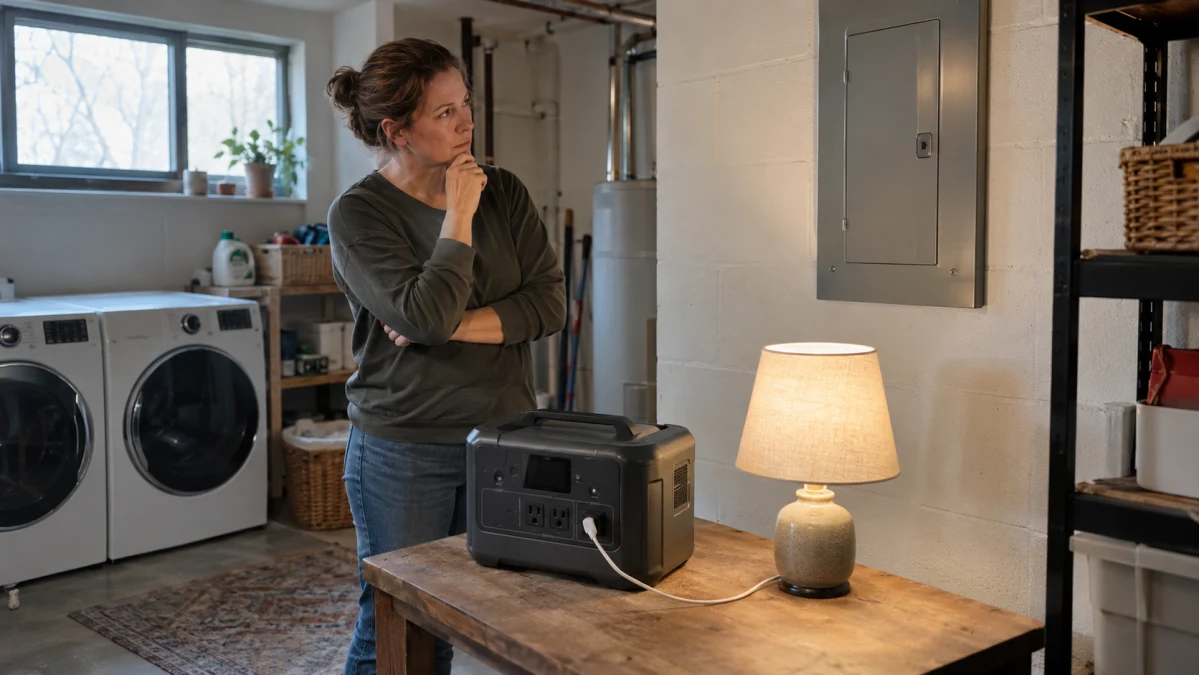
A portable power station and a home power kit are not really two different kinds of backup power. With the Anker SOLIX F3800 Plus, the battery can be the same in both setups. What changes is how that power reaches your appliances.
Use the station by itself and you plug individual devices into it. Add the Smart Home Power Kit and the station can feed selected household circuits through installed electrical equipment. That distinction matters more than the word “portable” or “home” in the product name.
The practical question is simple: during an outage, do you want to bring power to a few appliances, or keep using selected circuits around the house?
Direct backup is simpler when the important loads are easy to reach
If your outage plan is built around things you can physically plug into the station—such as a refrigerator, freezer, router, lamps, chargers, or other cord-connected equipment—a standalone power station avoids the cost and complexity of integrating backup power into the house.
That does not make the setup effortless. You still need to know which outlets on the station support each load, whether you need 120V or 240V, and how much everything will draw when it is running at the same time. Appliances with compressors or motors can also demand substantially more power for a short period when they start.
The Anker SOLIX F3800 Plus is unusually powerful for this kind of direct backup. Anker rates the US model at 3,840Wh of battery capacity and up to 6,000W of total AC output, with both 120V and 240V available in supported operating modes. Its L14-30R connection is rated up to 6,000W at 120/240V, while the TT-30R is rated up to 3,000W at 120V.
The important catch is that 6,000W is not what every outlet can deliver. Ordinary 120V outputs have their own limits, and the available ports can change depending on how the station is being charged. Match the appliance to the specific output you intend to use rather than treating the headline inverter rating as a universal socket rating.
There is also a practical limit hidden by the word “portable”: Anker lists the F3800 Plus at about 136.7 pounds. It has wheels, but this is better thought of as a movable large battery than something you will casually carry from room to room. Where it will sit—and whether cords can safely reach the loads you want to power—should be part of the plan before you buy it.
Battery capacity tells you more about runtime than the watt rating
A 6,000W inverter tells you how much power the system can supply at once. The 3,840Wh battery rating tells you roughly how much energy is stored.
Those numbers answer different questions.
If the appliances you want to keep running average 500W for four hours, they need 2,000Wh of energy at their inputs:
500W × 4 hours = 2,000Wh
That does not mean a 3,840Wh battery will necessarily run the same 500W load for 7.7 hours. The published capacity is nominal battery energy, while real AC runtime is affected by inverter losses, the station's own consumption, load behavior, temperature, and how much reserve remains when the system shuts down.
For buying purposes, calculate how many watt-hours your essential loads require and leave margin rather than dividing the advertised battery capacity by the appliance wattage and treating the answer as guaranteed runtime.
Startup power deserves the same attention. A refrigerator, pump, air conditioner, or other motor-driven appliance can briefly demand more than its normal running wattage. Check the appliance documentation and the limits of the exact output path you plan to use. A large total inverter rating does not automatically prove that every motor will start successfully from every outlet.
A home kit solves the cord-and-circuit problem, not the battery-capacity problem
Direct backup becomes awkward when the loads you care about are scattered around the house or connected through household wiring. Built-in lighting, permanently wired equipment, and appliances that are inconvenient to reach individually are where circuit-level backup starts to make more sense.
Instead of running cords from the power station, a properly installed home system routes backup power through electrical equipment to selected circuits. That also means the installation has to provide the required isolation from the utility grid. The Department of Energy's explanation of islanding illustrates why preventing backup generation from feeding utility lines is a fundamental safety requirement.
The Anker SOLIX F3800 Plus + Smart Home Power Kit + Installation Service packages the station with equipment intended for this type of household integration. But with a single F3800 Plus, the underlying battery is still 3,840Wh and the station is still rated at 6,000W. The home kit changes where the power can go; it does not turn one battery into a larger energy reserve.
That distinction becomes important when comparing Anker's configurations. The single-station Smart Home Power Kit option starts with one 3,840Wh F3800 Plus. The 12,000W, 7,680Wh configuration uses two F3800 Plus stations. Expansion batteries can add stored energy without doubling the station's normal inverter output, while a second station is part of Anker's higher-output dual-system configuration.
In other words, buy additional battery capacity when the problem is runtime. A more elaborate connection to the house does not by itself make the outage last longer.
Check your electrical service before assuming the home kit will fit
The Smart Home Power Kit listing identifies a Home Power Panel, subpanel, circuit breaker, and ground bar as part of the system. Anker states that its Home Power Panel is designed for 120/240V split-phase service and does not support 120/208V systems.
That is the sort of compatibility issue worth resolving before ordering hardware.
The installation plan should also identify which circuits will receive backup power, how the station connects to the panel, what additional wiring or electrical work the house requires, and whether permits or inspections apply. Anker sells an F3800 Plus bundle with installation service, but the existence of an installation package should not be treated as proof that every site-specific change is automatically covered.
The advantage, when the house and installation are compatible, is straightforward: instead of deciding which refrigerator, light, or outlet gets an extension cord after the power goes out, the selected circuits already have a defined backup path.
Recharging can change which outputs are available
This is one of the easiest specifications to overlook.
The F3800 Plus can provide 120V and 240V output when operating from its battery in supported configurations, but Anker says the 240V output is unavailable while the station is charging from a 120V AC wall source.
Anker lists 1,800W as the maximum 120V AC charging input and 1,440W as the bypass limit in that operating mode. So if your outage strategy involves keeping equipment powered while simultaneously recharging the station from ordinary 120V AC, do not assume the normal 6,000W output specification still describes what is available.
That matters especially for a plan built around a 240V load. Work out not only how the appliance runs from the battery, but also what happens to that appliance while the battery is being replenished.
Solar can extend an outage, but only through the right path
Anker rates the F3800 Plus for up to 3,200W of direct solar input, split across two inputs rated at 11–165V and up to 1,600W each. Anker advertises a full recharge in under two hours under optimal sunlight.
Treat that as a best-case manufacturer claim, not a normal daily expectation. Clouds, season, panel angle, temperature, shading, available panel area, and power being consumed while charging all affect how quickly the battery recovers. Panel compatibility also depends on the electrical limits of the inputs, not simply whether the panels' advertised wattages add up to 3,200W.
There is another important limitation for homes that already have rooftop solar. Anker says the F3800 Plus cannot be recharged from rooftop panels through the Home Power Panel during an outage. For outage charging, Anker directs users to compatible 11–165V solar panels connected directly to the F3800 Plus solar inputs.
So an existing grid-tied rooftop array should not automatically be counted as an outage-time charging source for this system. Verify exactly how the array and battery interact when the grid is down.
Generator charging has its own set of limits
The F3800 Plus also adds generator support, but “6,000W generator charging” can be misleading if read as one universal number.
On its F3800 Plus installation-service page, Anker distinguishes between battery charging and generator bypass. Its published material states 3,300W of generator charging for a single F3800 Plus and up to 6,000W when at least one expansion battery is attached. Separately, supported 240V generator configurations can provide up to 6,000W of bypass power through the appropriate connection.
Those are different jobs: one figure describes how quickly energy can be put back into the battery system, while the other describes generator power passing through a supported path to loads. The exact available outputs also depend on whether the input is a 120V generator, a 240V generator, or ordinary 120V wall power.
If generator use is central to your outage plan, decide on the generator, connection method, charging configuration, and loads together rather than buying each component independently and assuming the maximum numbers will all apply at once.
Which setup makes more sense?
Choose the F3800 Plus by itself when the essential devices are easy to reach, their plugs and voltages match the station, and you are comfortable managing which devices are connected during an outage. It gives you the battery and high-output capability without turning the purchase into an electrical-installation project.
Choose the F3800 Plus with a Smart Home Power Kit when the bigger problem is distribution: important loads are on different household circuits, some are inconvenient or impossible to plug directly into the station, or you want selected circuits to have a dedicated backup path.
Do not choose the home kit simply because it sounds like the more powerful option. With one F3800 Plus, it starts with the same 3,840Wh battery. If your real problem is that the battery will not last long enough, additional storage matters more. If your real problem is getting power safely and conveniently to the right places in the house, circuit integration is what changes the experience.