
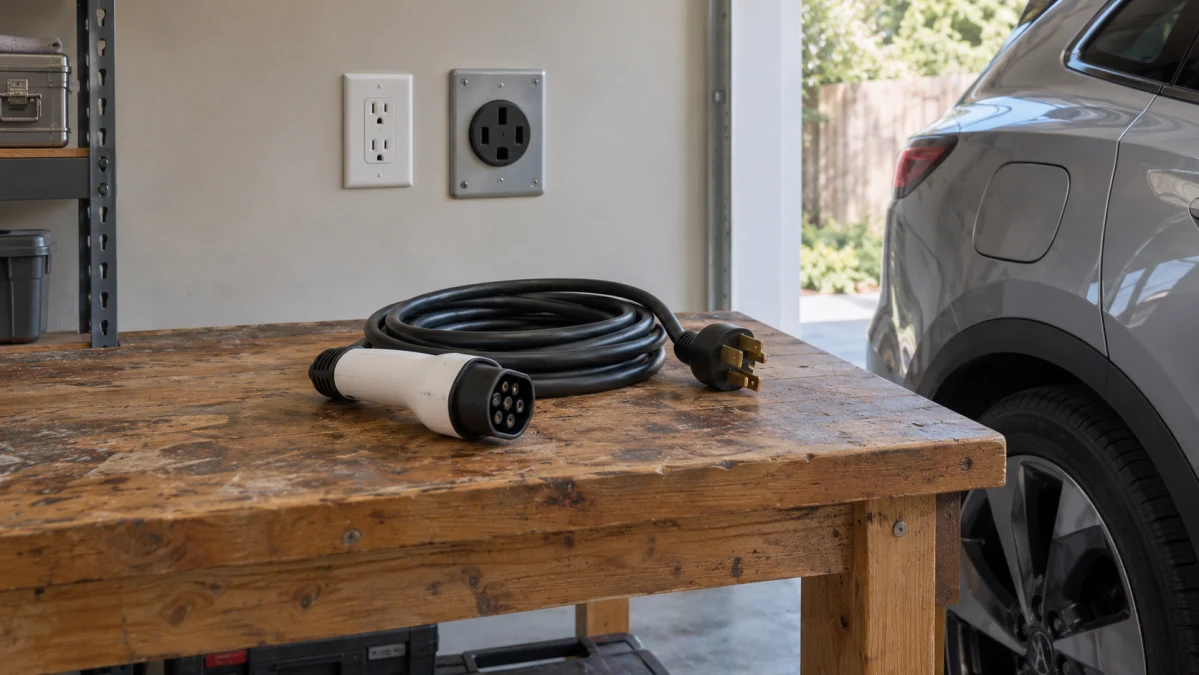
The two portable VEVOR chargers here solve different problems. The Level 1 & 2 EV Charger, model EV-ACS1602U/K3, trades charging speed for flexibility: it has a NEMA 6-20P plug for 240V charging and includes a NEMA 5-15 adapter for an ordinary 120V household outlet. The Level 2 EV Charger, model EV-ACS4001U/K3, is the faster option, with a NEMA 14-50P plug and up to 40A at 240V, but its documented package does not provide the same household-outlet fallback.
That distinction matters more than the Level 1 or Level 2 label. Before buying either charger, check the outlets where you will actually use it, the available circuit capacity, and the charging inlet on your vehicle.
If a 120V outlet may be your only option
A 120V outlet can be useful at a relative's house, a vacation property or any other place where dedicated 240V charging is unavailable. It will be much slower than a higher-power Level 2 connection, but it can still be valuable as a fallback.
The U.S. Department of Energy describes Level 1 charging as 120V AC charging and Level 2 as 208V or 240V AC charging. Actual charging time depends on the vehicle as well as the available electrical supply, so the important question is not simply whether a charger supports two voltage levels, but whether you can safely connect it to the outlets you expect to encounter.
The Level 1 & 2 EV Charger provides the clearest path for that use case. VEVOR specifies model EV-ACS1602U/K3 for both 120V and 240V operation. Its instructions specify:
- 120V at 12A through the included NEMA 5-15 adapter, with a 15A circuit breaker
- 240V at 16A through the NEMA 6-20 plug, with a 20A circuit breaker
- a maximum output of 3.84 kW
- an SAE J1772 vehicle connector
In practical terms, this is the more flexible charger but not the faster one. At 120V and 12A, its maximum input is 1.44 kW. At 240V and 16A, that rises to 3.84 kW. How quickly that translates into battery range depends on the vehicle, but moving from the household outlet to the documented 240V connection substantially increases the amount of energy the charger can deliver over the same number of hours.
The limitation is on the 240V side: the charger's native plug is NEMA 6-20P. If the garage or destination has only a NEMA 14-50 receptacle, this package does not by itself give you a documented connection to it. Do not assume that any adapter that physically joins the two plugs makes the arrangement appropriate for EV charging.
If you already have a NEMA 14-50 outlet
If your main charging location has a suitable 240V NEMA 14-50 receptacle, the 40A model offers a much higher charging ceiling.
VEVOR lists the Level 2 EV Charger, EV-ACS4001U/K3, as a 240V, 40A charger with a NEMA 14-50P plug and SAE J1772 connector. Its maximum rated output is 9.6 kW.
That is 2.5 times the maximum power of the 3.84 kW VEVOR 1602 on its 240V connection. Your car's onboard AC charger can impose a lower limit, so buying a 9.6 kW EVSE does not guarantee the vehicle will accept the full 9.6 kW. But for a vehicle that can take advantage of the additional power, the difference can be significant during an overnight charge.
The EV-ACS4001U/K3 manual specifies a NEMA 14-50 plug, a 40A maximum and a 50A circuit-breaker requirement. The outlet also needs to be properly grounded.
There is one specification that deserves caution. The manual lists the charger's input range as 110–240V, even though VEVOR's retail page identifies it as a 240V Level 2 product with a NEMA 14-50P plug. That broad voltage entry does not establish a usable household 120V setup. No NEMA 5-15 adapter or other complete 120V wall connection is documented for this package. If 120V charging is important to you, the 1602 has the much clearer manufacturer-documented path.
Check the car side as carefully as the wall side
Both VEVOR versions discussed here use SAE J1772 connectors. That is convenient for vehicles with a compatible J1772 AC charging inlet, but it is not a universal vehicle connector.
If your car has a different inlet, such as NACS, verify the exact vehicle-side adapter arrangement supported for your vehicle before buying the charger. Do not assume that an adapter is included simply because a seller describes a charger as broadly compatible.
This is separate from the wall-plug question. A wall adapter changes how the EVSE connects to electrical service; a vehicle adapter changes how the charging cable connects to the car. You may need compatibility on both ends.
The circuit matters more than whether the plug fits
A NEMA receptacle tells you the physical interface. It does not tell you whether the wiring behind it, the breaker, grounding or the rest of the branch circuit is appropriate for sustained EV charging.
The Department of Energy's home-charging guidance notes that EV charging is treated as a continuous load under the National Electrical Code and that Level 1 home charging assumes an available outlet on a dedicated branch circuit. Level 2 installations may require a new circuit, and local electrical and permitting requirements also apply.
For the two VEVOR models, the manufacturer's instructions give concrete requirements: the 1602 calls for a 15A circuit with its 120V NEMA 5-15 adapter or a 20A circuit with its 240V NEMA 6-20 connection, while the 4001 specifies a 50A breaker for its 40A maximum operation.
A selectable lower current on a charger should not be treated as permission to use an otherwise undocumented outlet, adapter or circuit. If you do not know how the receptacle is wired or whether the circuit is suitable for continuous EV charging, have a qualified electrician check it before relying on that connection.
When a fixed home charger makes more sense
Portable charging equipment is useful when the charger needs to travel with the car or when you regularly use more than one suitable outlet. If almost all charging happens in the same garage or driveway, a hardwired Level 2 charger may be the cleaner solution.
The AC Lite Home EV Charger is one example. The retailer listing identifies the J1772 version as Autel SKU MAXI US AC LW12KW-DK and as a hardwired charger. Autel's specifications for the AC Lite Home 50A family list 208/240V input, adjustable 6–50A output, up to 12 kW at 240V, a 25-foot charging cable and hardwired installation.
That makes it a fundamentally different purchase from the two portable VEVOR units. You give up the ability to unplug the EVSE and take it elsewhere, but you also avoid choosing a portable charger around whatever receptacle happens to be installed in one garage. The installation can instead be designed around the charger, the home's electrical capacity and the vehicle's charging needs.
Because the retailer uses a more specific SKU than the model designation shown on Autel's family page, verify the installation documentation supplied with the exact unit before purchase and have the circuit sized for that particular configuration.
Which one fits which situation?
Choose the Level 1 & 2 EV Charger when access to an ordinary 120V NEMA 5-15 outlet is an important fallback and 16A Level 2 charging is fast enough for your needs. Its included 5-15 adapter and documented 120V operating mode are the key advantages.
Choose the Level 2 EV Charger when you have a suitable NEMA 14-50 outlet and want substantially more Level 2 power. Its 40A, 9.6 kW ceiling is the meaningful advantage; the manual's 110–240V input specification should not be mistaken for a documented household-outlet setup.
Consider a hardwired charger such as the AC Lite Home EV Charger when charging happens primarily at one location and portability has little value.
If you need one portable charger to cover both a standard NEMA 5-15 household outlet and a NEMA 14-50 location, neither of these two VEVOR packages documents that complete combination out of the box. In that situation, look for a charger whose manufacturer explicitly documents every voltage, plug or approved adapter you intend to use. With EV charging, a plug that can be made to fit is not the same thing as a connection the charger was designed to use.