
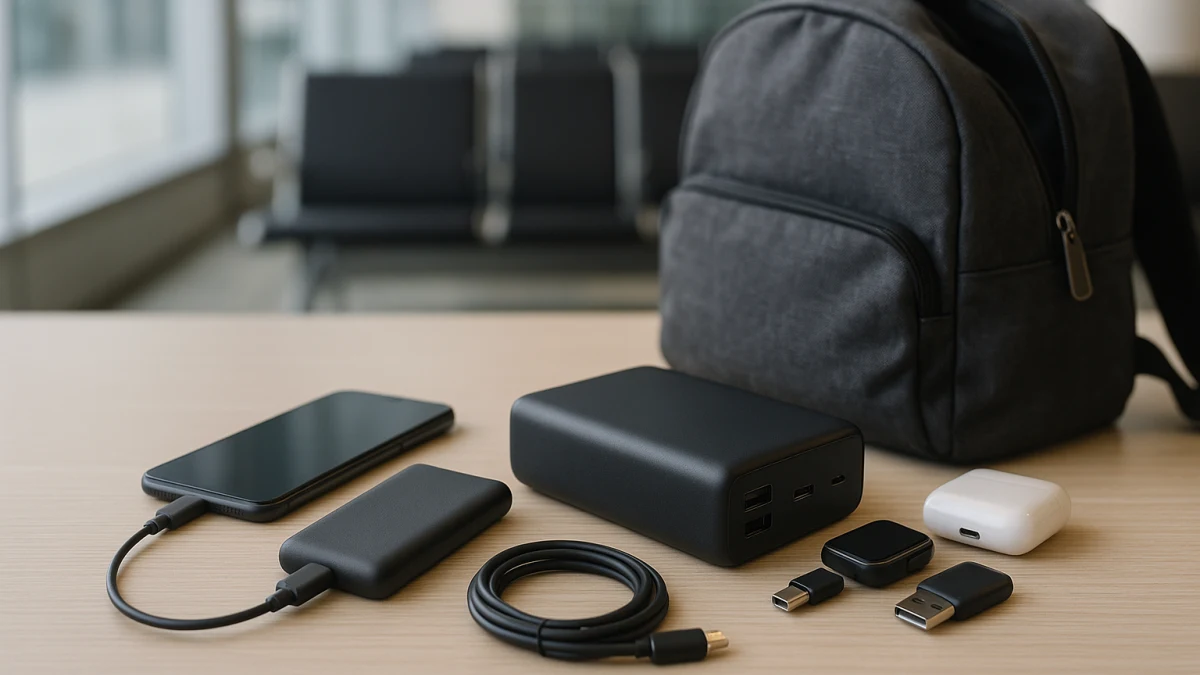
A travel-day power bank is mainly a carry tradeoff: do you want the smallest backup that is comfortable in a pocket or compact bag, or enough reserve energy to stay away from outlets for most of the day? A typical power-bank listing can mix 5,000mAh mini packs, 10,000mAh everyday models, 20,000mAh-plus batteries, and laptop-capable chargers even though they solve different problems.
Use this page to compare by job first: carry size, capacity class, output power, ports, and the point where laptop charging becomes a separate requirement. The main comparison stays focused on portable battery packs for travel-day phone and small-device backup; wall chargers, solar chargers, portable power stations, and other off-grid power products are outside the core scope.
Pick by carry comfort or outlet-free time
| If your travel day looks like this | Better fit |
|---|---|
| One phone, occasional top-ups, and minimum weight or bulk | Pocketable 5K/10K-style power bank |
| Long flights, train rides, sightseeing, events, several devices, or shared charging | Higher-capacity 20K-plus power bank |
| A laptop is one of the devices you actually need to recharge | High-output USB-C laptop-capable power bank |
| You need wall power, solar input, very large energy storage, or off-grid equipment support | Use a different product category |
Start with the battery job, not the biggest mAh number
Before comparing models, decide what problem the power bank needs to solve.
- If carry comfort matters most, check listed dimensions, thickness, and weight rather than relying on words such as mini, slim, compact, or pocket-size.
- If long outlet-free stretches matter most, compare larger-capacity packs and accept the extra space and weight they require.
- If you will charge several devices, compare the number and type of ports as well as whether the available output is shared between them.
- If fast charging matters, look at supported output power and charging standards instead of assuming that a larger battery charges devices faster.
- If a laptop is part of the plan, output wattage and USB-C charging compatibility become at least as important as capacity.
Capacity and charging power are different specifications. A higher-mAh power bank can store more energy without necessarily delivering more watts, while a smaller model can sometimes provide faster phone charging than a larger but lower-output pack.
Treat mAh, Wh, wattage, size, and recharge counts separately
These specifications answer different questions:
- mAh is commonly used to describe battery capacity.
- Wh describes stored energy and is especially important when checking flight restrictions.
- W describes charging power, not battery capacity.
- Weight and dimensions determine whether the pack is realistically pocketable or belongs in a day bag.
- Port specifications determine which devices can connect and how charging power may be distributed.
Do not calculate an exact number of phone recharges from the power bank's advertised mAh alone. The power bank and phone operate at different battery voltages, and energy is lost during voltage conversion and charging. Treat manufacturer recharge estimates as product-specific claims rather than a direct conversion from the headline mAh figure.
If you need to convert a battery specification to watt-hours and the required voltage is provided, the basic relationship is:
Wh = V × Ah
For a value given in mAh, divide by 1,000 first to obtain Ah. When a power bank itself is marked with a Wh rating, use that marked value when checking transport requirements rather than estimating from the marketing capacity if you do not need to.
Check flight rules separately from the shopping decision
Do not assume that phrases such as airline approved, TSA approved, travel approved, or flight safe are enough to establish whether a particular power bank is permitted on your trip.
Before flying, check:
- the power bank's marked Wh rating;
- whether power banks must remain in carry-on baggage;
- any capacity or quantity restrictions that apply;
- whether larger batteries require airline approval;
- your airline's own rules, especially on international itineraries.
Airline and aviation-authority requirements are a separate verification step from deciding whether a battery has the right size, capacity, and output for your travel day.
Pocketable power banks: when 5K/10K-style backup is enough
Choose this lane when the main problem is keeping one phone alive through a normal travel day without carrying a large battery.
Compact 5,000mAh- and 10,000mAh-class models are usually the first place to look when portability matters more than maximum reserve energy. The useful comparison is not simply 5K versus 10K, though. Check how each product balances:
- listed weight;
- thickness and overall dimensions;
- USB-C input and output;
- supported charging power;
- built-in cable or connector features, if useful to you;
- number of devices that can be connected.
A small battery that disappears into a belt bag can be more useful than a larger one you stop carrying because of its weight. Conversely, choosing the smallest possible model is a poor trade if you already know you will need repeated charging during the day.
Read this lane as light backup rather than maximum endurance. It is best suited to a phone top-up, emergency reserve, or a travel day where outlets are likely to appear eventually. If several devices or a long outlet-free stretch are part of the plan, compare the higher-capacity group instead.
The pocket test: weight, thickness, and actual dimensions
Pocketable is a practical description, not a standardized product class.
Check three physical specifications together:
- Weight: decide whether you are comfortable carrying it all day in the location you actually use.
- Thickness: a flatter pack can be easier to carry than a thicker battery even when their headline capacities are similar.
- Dimensions: compare the listed measurements with a pants pocket, jacket pocket, belt bag, crossbody compartment, or organizer pocket rather than relying on product photos.
Also account for the charging setup. A compact battery can become less convenient if it requires a long loose cable, while a built-in cable or connector can reduce what you need to carry. That convenience should still come after the core checks for capacity, output, physical size, and device compatibility.
High-capacity power banks: when reserve energy earns the bag space
Move into the 20,000mAh-plus lane when the travel day itself justifies carrying a larger battery: long flights, train journeys, conferences, theme parks, sightseeing, events, navigation-heavy days, multiple devices, or shared charging with another traveler.
Here, compare more than capacity. A larger power bank earns its extra bag space when it also provides the connection and output options you need.
Look for:
- sufficient USB-C and/or USB-A ports;
- output wattage appropriate for your devices;
- whether maximum output changes when several ports are used;
- useful remaining-charge information;
- listed size and weight;
- the power bank's Wh rating when air travel is relevant.
Do not assume that a 20K-plus battery is automatically the better travel choice. If you normally need only one partial phone recharge, much of that reserve may become unnecessary weight.
Use this group when longer outlet-free coverage matters more than pocket comfort. For phone-first travel with heavier usage or several devices, this is usually the relevant comparison. If the reason you are moving to a larger pack is specifically laptop charging, check the next section before choosing.
When a large power bank becomes a laptop-charging decision
Capacity alone does not make a power bank suitable for a laptop.
Once a listing emphasizes laptop charging, MacBook compatibility, USB-C Power Delivery, or outputs such as 65W, 100W, or higher, the decision changes. You now need to check whether the power bank can supply the power profile required by the laptop rather than simply whether it stores enough energy.
Important checks include:
- maximum USB-C output from the relevant port;
- supported charging protocol;
- laptop charging requirements;
- whether the advertised maximum applies to one port or total combined output;
- what happens to output when several devices are connected;
- cable requirements for the advertised charging rate.
A high-capacity phone power bank can still have insufficient output for useful laptop charging. Likewise, a high-output model may be unnecessary if your travel setup is phone-only.
Boundary check: laptop-class packs should stay a separate lane
Use this group only when high-output USB-C charging is genuinely part of the requirement.
For phone-only travel, paying for laptop-level output, additional ports, and a larger chassis may add features you do not need. For actual laptop charging, verify the specific laptop, port, cable, charging protocol, and output specification rather than relying only on a large wattage number in the product title.
Final travel-day power bank check
Before choosing, run through the factors that determine whether the pack fits the trip:
- Capacity: Is a 5K/10K-style backup enough, or does the day justify 20,000mAh-plus reserve?
- Carry location: Will the pack actually live in a pocket, belt bag, crossbody, day bag, or backpack?
- Size and weight: Are the listed dimensions and weight acceptable for that location?
- Ports: Do you need to charge one device or several?
- Output: Does the relevant port provide the charging power your device can use?
- Multi-port behavior: Does available output change when multiple devices are connected?
- Laptop requirement: Are you really charging a laptop, or only being drawn toward larger wattage numbers?
- Recharge claims: Are any claimed recharge counts supported by the product or manufacturer information?
- Flight check: If flying, have you checked the marked Wh rating and the current rules for your airline and itinerary?
The best travel-day power bank is usually not the model with the largest capacity or highest wattage. It is the smallest and lightest pack that still provides enough usable reserve, ports, and output for the devices you expect to charge before you reach the next reliable outlet.