
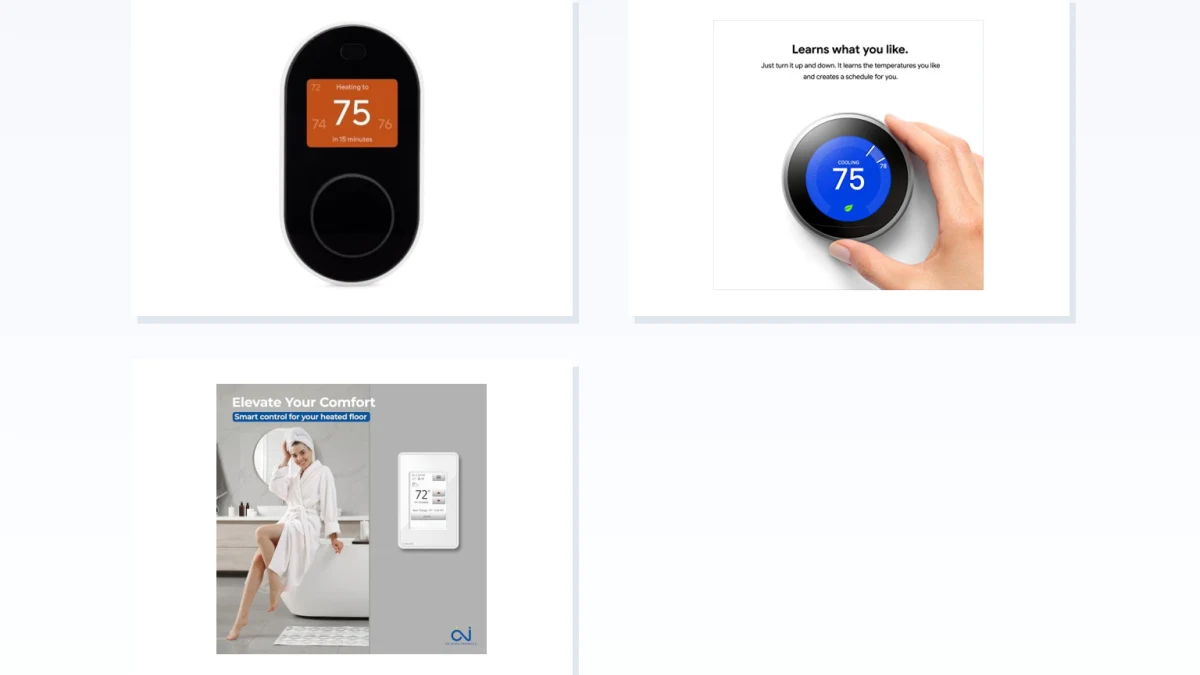
Most smart thermostat category pages answer one question: does this model work without a C-wire? This page splits that question in two. The no-C-wire fix happens either at the furnace or air handler control board with an included adapter, power extender, or PEK, or at the wall with a battery-powered or power-stealing thermostat. A third group—line-voltage, electric baseboard, and electric floor-heating thermostats—looks like a smart thermostat in search results but belongs to a different wiring class and should be ruled out before it contaminates the choice.
That separation matters more than the thermostat's smart features. A normal category listing mixes adapter models, battery models, and line-voltage products without saying that one group needs a control-board install, another is a simpler wall swap, and the third should not be on the same recommendation path. Across this page, compare the two low-voltage paths on four axes: where the no-C-wire fix physically happens, how much wiring confidence each install requires, what upkeep follows, and how much compatibility checking the manufacturer documentation demands. The line-voltage boundary stays separate.
Start With Your Wiring and DIY Comfort Level
Use the wiring you can see and the install you are willing to do to choose a lane before comparing models.
- I see no C-wire at the wall and I am comfortable opening the furnace or air handler control board — better fit: included power extender/adapter no-C-wire models.
- I want a wall-only swap without a separate adapter and I can accept battery replacement or power-stealing quirks — better fit: battery-powered or power-stealing no-C-wire models.
- My heat is electric baseboard, radiant floor heat, or a 120V/240V thermostat — exit this low-voltage comparison and use a line-voltage/baseboard thermostat page instead.
Low-Voltage Only: What This No-C-Wire Guide Can and Cannot Do
This page covers low-voltage 24V smart thermostats that can work without an existing C-wire. It excludes electric baseboard, line-voltage, electric radiant floor heat, separate transformers, running new thermostat cable, heat pump staging, and multi-zone control. If your system falls into one of those later categories, the two core sections below are not the right purchase path.
Furnace-Side Power Fix: Models With an Included C-Wire Adapter or Power Extender
These products solve the no-C-wire problem at the furnace or air handler control board. The listing language to look for is explicit: 'C-wire adapter included', 'C-Wire Adapter Included: Yes', and product titles such as 'Smart Thermostat with C-Wire Adapter'. Power extender and PEK wording belongs to the same lane. Because the fix moves to the control board, this is an installer-side decision rather than a universal out-of-box fix, so compare the models on control-board access and the wiring confidence they require instead of treating the section as a simple wall swap.
Read the cards for inclusion wording rather than price or star rating. An included adapter or PEK can reduce the need to buy a separate part, but it does not remove the control-board work or prove compatibility with your furnace, air handler, boiler, or heat pump board. If you cannot access the control board or label its wiring, the wall-only battery lane below is the lower-effort alternative—not an equal-effort drop-in.
Adapter Compatibility Must Come From Manufacturer Docs, Not the Listing
Included-adapter language such as 'C-wire adapter included' only confirms that the part is in the box. It does not say the adapter works with every furnace, air handler, boiler, or heat pump control board. Before choosing a model in this lane, check the manufacturer's compatibility documentation for your specific control board and model. The product page alone is not enough for that claim.
Wall-Only Swap: Battery and Power-Stealing Models That Skip the Separate Adapter
This lane is for the wall-only swap: smart thermostats described as battery-powered or power-stealing, without a separate adapter, PEK, or outlet requirement. The recognizable pattern here includes Nest Learning Thermostat 3rd Gen, Nest Learning Thermostat with Temperature Sensor, a Smart Color Thermostat listed as battery-powered, and a model that lists three 1.5V batteries. With no control-board adapter, the install decision moves back to the wall, while the tradeoff moves into battery replacement and older-system power-stealing behavior.
Use the cards to compare the simple-swap set, not to assume identical behavior on every older system. A product listing may say 'battery-powered' without stating a single replacement interval for your usage, and power-stealing behavior can vary with the specific heating and cooling system. If avoiding control-board work is the priority, this is the lane to compare first. If you want the power solution handled at the HVAC equipment and are willing to verify the control board, the adapter lane above is the other valid path.
Battery Life and Power-Stealing Behavior Are Not a Single Warranted Number
Listings in this lane do not standardize battery life or replacement intervals. Some models run on three 1.5V batteries; others rely on power stealing, which may behave differently on older systems. Wi-Fi and schedule use can also change how often a model needs attention. Treat the product page as the source for whatever is stated, and accept that a stated battery figure may not apply to your specific system.
Line-Voltage and Baseboard Thermostats Are Not This Problem
This section is a rule-out flag, not a third buying path. If your heat is electric baseboard, electric radiant floor heating, or a 120V/240V line-voltage thermostat, the products below are the wrong class for a low-voltage no-C-wire smart thermostat. The listings referenced here include electric radiant floor heating thermostats, floor-warming systems, and line-voltage products, with some mentioning GFCI or brands such as Nuheat and Schluter.
Do not use this list to pick a low-voltage C-wire workaround, and do not compare its features against the two sections above. Its only job is to confirm that you should leave this low-voltage comparison and look at a line-voltage or baseboard thermostat page instead.
Pre-Purchase Wiring Checklist: Confirm C-Wire, Control Board, and System Type Before Buying
- Check the existing thermostat wiring first. If a C wire or C terminal is already present, a no-C-wire workaround may not be needed. When in doubt, photograph the wiring labels before shopping.
- For the adapter lane, locate the furnace or air handler control board and confirm you can access and identify the terminals. Check the exact control-board model against the thermostat manufacturer's compatibility documentation.
- For the battery lane, confirm the listing describes battery or power-stealing operation, and note whether any battery type, count, or replacement guidance is documented.
- Rule out line voltage before choosing either path: electric baseboard, electric radiant floor heat, a 120V/240V thermostat, a separate transformer, or a floor-warming system means this collection is the wrong page.
Stop Before Purchase If You Need Heat Pump Staging, Multi-Zone Control, or New Cable
This comparison keeps a narrow scope: low-voltage 24V smart thermostats that work without an existing C-wire. Heat pump staging, multi-zone control, separate transformers, and running new thermostat cable are outside that scope. If any of those requirements is part of your install, neither the adapter lane nor the battery lane above is the right recommendation from this page. Stop here and find a solution that matches the full wiring requirement.
After those boundary checks, the decision returns to two valid low-voltage no-C-wire paths: an included adapter installed at the furnace or air handler, or a battery and power-stealing model that keeps the change at the wall. Before installing either, confirm the existing thermostat wiring labels and check the adapter model against the manufacturer's documentation for your specific control board.