
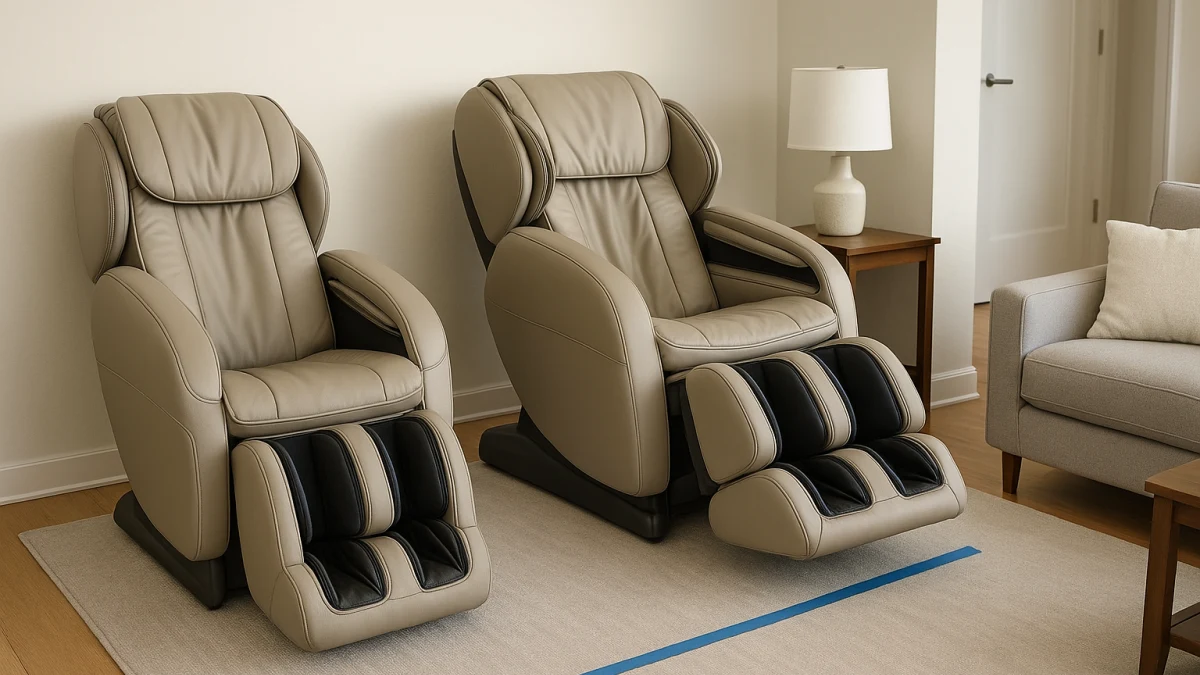
A massage chair can look compact in a product photo and still need a very different space once the backrest reclines and the footrest extends. If you are shopping for an apartment, bedroom, den, or tight living room, the real first question is not which massage feature sounds better. It is how the chair moves through the room.
This collection separates near-wall candidates from fuller-recline candidates by placement risk: rear wall clearance, front footrest travel, full-recline footprint, chair width, and delivery dimensions. A normal product grid may place zero-wall, wall-hugger, full-body, zero-gravity, and smart-looking chairs side by side; here, the goal is to help you decide which recline path your room can actually support.
Let the recline path choose the lane first
| If your situation is... | Better fit to compare first |
|---|---|
| The chair has to sit close to a wall in an apartment, bedroom, den, or other tight room. | Start with zero-wall or space-saving massage chairs, then verify the exact wall clearance and front footrest travel. |
| You have open space behind the backrest and in front of the footrest, and recline depth matters more than near-wall placement. | Compare full-recline massage chairs with more clearance, especially models with zero-gravity, full-body, or extended footrest details. |
| You mainly want compact controlled seating, not automated full massage programs. | Treat smart chairs as a boundary alternative, not as a replacement for the massage-chair lanes below. |
| You only know the upright length and width of the chair. | Pause before choosing either lane and check the full-recline footprint, rear clearance, footrest extension, chair width, and delivery dimensions. |
Use the same six checks as you compare: rear wall clearance, front footrest travel, upright versus full-recline footprint, chair width, delivery or entry dimensions, and the tradeoff between massage coverage and placement flexibility. A chair that wins on one of those can still fail on another.
Rear wall, front footrest, width: the three-way fit test
Before looking at features, picture the chair in motion:
- Back wall: zero-wall, wall-hugger, rear-clearance, and reclining-distance language tells you whether the chair is intended to recline near a wall or needs open space behind it.
- Front footrest: auto footrest extension, calf or leg extension, retractable footrests, and deeper recline can push into a walkway even when the rear clearance looks safe.
- Side clearance: chair width matters in corners, bedrooms, dens, and rooms with door swings or narrow side passages.
If any one of those zones is tight, do not let massage programs, heat, or premium comfort language make the decision for you. Clearance comes first.
Do not shop by upright dimensions alone
Overall length and width are only the starting point. A chair may publish upright dimensions, but the placement decision also depends on the manufacturer’s reclining wall distance, the space required in a zero-gravity or full-recline position, and how far the footrest travels forward.
For a small room, also check chair width and delivery dimensions. A massage chair that fits the final corner can still be a poor choice if it crowds a doorway, blocks the walking path, or cannot move through the entry route.
Smart chairs and ordinary recliners are not shortcut massage chairs
Smart chairs and ordinary recliners can be tempting when space is tight because they may look simpler or more compact. Treat them as boundary cases. If your main need is compact controlled seating, they may belong in a separate search. If your main need is an automated massage chair with full programs, recline behavior, footrest movement, and massage coverage, compare the two massage-chair lanes below instead.
The same caution applies in the other direction: a massage chair with smart controls is still a massage chair if its fit depends on rear clearance, footrest travel, and full-recline footprint.
Zero-wall massage chairs when the back wall is the limiter
Use this lane when the back wall is the main constraint. Listings may use terms such as zero-wall, wall hugger, wall clearance, space-saving, or reclining wall distance, but those phrases are shortlist clues, not guarantees that the chair can touch the wall.
The exact number matters. Some space-saving listings cite very low reclining wall distances, such as about 1.97 to 3.5 inches, while another may describe an 8-inch space-saving clearance. Those are meaningfully different room plans. Also check whether the chair has auto footrest extension, calf or leg extension, or a wider body that could create a new clearance problem in front or at the sides.
Read the products shown here as near-wall candidates to investigate, not final fit promises. Open each product page for the manufacturer’s rear clearance, full-recline footprint, footrest travel, chair width, and delivery dimensions. If a chair highlights SL-track, zero-gravity positions, or full-body features, keep those features secondary until the wall and footrest measurements work for your room.
Where zero-wall claims can still surprise you
The most common mistake is treating zero-wall as if it always means flush against the wall. It does not. It usually means the chair is designed to reduce rear clearance, and the exact distance still varies by model.
Watch for these wrong-choice patterns:
- Only measuring behind the chair: the footrest may extend into a walkway, closet path, or TV-viewing area.
- Ignoring the width: a low-clearance chair can still crowd a bed, door swing, side table, or den corner.
- Comparing only massage features: a fuller feature set does not automatically make a chair a better small-room fit.
- Skipping the delivery path: package size, entry width, stairs, and hallway turns matter before delivery day.
If the rear wall is non-negotiable, stay in the zero-wall lane until the actual clearance numbers are clear.
Full-recline massage chairs when the room can breathe
Choose this lane when you can give the chair more room behind the backrest and in front of the footrest. Full-body, full-recline, zero-gravity, SL-track, 150-degree, 165-degree, and retractable-footrest language often points to a chair built around a deeper recline setup rather than the tightest wall placement.
That can be the better choice if recline feel and massage coverage matter more than keeping the chair close to a wall. But this lane should not be treated as a small-room shortcut unless an individual listing also gives clear wall-clearance information.
Use the products shown here to compare larger-recline setups: how far the backrest goes, how the footrest extends, whether the listing shows overall dimensions, and whether the chair’s width works in your room. If you cannot spare open space behind and in front, return to the zero-wall lane instead of assuming a zero-gravity or full-body chair will fit.
Final fit check before delivery day
Before purchasing, confirm the fit with the product page or manufacturer details:
- Rear wall clearance or reclining wall distance.
- Full-recline footprint, not just upright dimensions.
- Front footrest travel, including auto, calf, leg, or retractable extension.
- Chair width at the arms and sides, especially near doors, beds, tables, or walkways.
- Delivery dimensions, package size, and any entry-path or minimum door-width notes.
- The route from the outside door to the final room, including stairs, turns, hallways, and tight corners.
The right lane is the one your measured room supports. Start with zero-wall or space-saving models when the wall is the limiter; choose a fuller-recline chair when the room can handle the larger footprint and you want the deeper recline setup.