
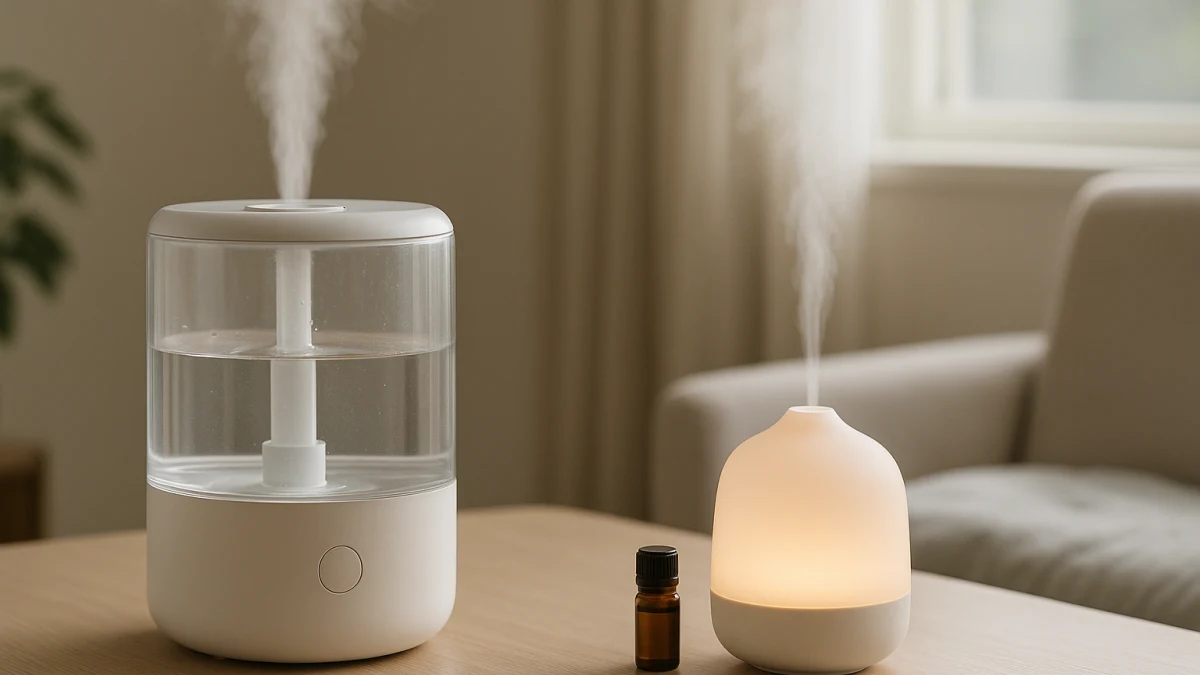
Humidifiers and essential oil diffusers can both create a visible mist, which is exactly why they are easy to confuse. The safer way to shop is not by the cloud you see, but by the job the device is built around: tank-supported room moisture or oil-based scent delivery.
A normal category page can place humidifiers and diffusers next to each other, but it may not explain why lights, a small reservoir, or fog-like output do not make them interchangeable. Use this page to compare the clues that matter: tank capacity, runtime, mist type, room-use wording, top-fill access, timers, LED lighting, remote or smart controls, cold-air diffusion, and maker-approved oil use.
Decide by the job, not by the mist
| If you need to... | Better fit | What to check first |
|---|---|---|
| Raise humidity in a bedroom, office, nursery, or dry living space | Humidifier for room moisture | Humidifier naming, tank capacity, runtime, mist type, and room-use wording |
| Add essential oil scent, aroma scheduling, LED ambiance, remote control, or smart scent control | Essential oil diffuser for fragrance | Essential oil, aroma, timer, light, remote, Wi-Fi, Bluetooth, or scent-machine language |
| Choose a small decorative device mainly because it produces visible mist | Verify before treating it as a room humidifier | Tank size, runtime, and whether the product page actually describes room use |
| Filter particles, remove odors, dry out a damp room, or add whole-home humidity | Neither path here | Look outside this collection |
Five comparison points keep the decision clean: the primary job, tank capacity and runtime, mist claims versus room-use claims, controls and ambiance, and maintenance or oil compatibility. A 3L or 3000ml tank with 6 to 12 hour runtime belongs in a different decision than a 300ml, 500ml, or 600ml scent diffuser with timers and LED lights.
Mist is not the deciding signal
Look past the mist effect and sort the product by its strongest practical cues:
- Moisture-oriented cues: humidifier naming, larger tank language such as 3L or 3000ml, warm mist, cool mist, ultrasonic or vaporizer wording, bedroom or large-room use, 6 to 12 hour runtime, auto shut-off, top-fill access, dishwasher-safe tank cleaning, 360-degree spray, or dual nozzles.
- Scent-oriented cues: essential oil diffuser naming, aroma or aromatherapy labels, 300ml to 600ml capacity, timer settings, LED lights, remote control, Wi-Fi or Bluetooth control, automatic shut-off, quiet operation, long aroma runtime, cold-air diffusion, or scent coverage claims.
- Borderline cues: visible fog, decorative lighting, USB power, or a small water tank. These can be useful features, but they do not prove that the device is intended for meaningful room humidity.
Not an air purifier, dehumidifier, or aromatherapy-benefits guide
This comparison is only about choosing between room-moisture devices and essential-oil scent devices. It does not cover air purifiers, odor-removal machines, dehumidifiers, or whole-home humidification systems.
It also does not treat fragrance as a medical or respiratory solution. If your goal is symptom relief, allergy control, mold prevention, pet safety, child safety, or air-quality treatment, you need source-backed guidance beyond what a mist device listing can provide.
Choose a humidifier when moisture is the real goal
If the room feels dry and the job is adding moisture, start in the humidifier lane. The products shown here are most useful to compare by humidifier naming, tank size, mist type, runtime, room-use language, auto shut-off, top-fill cleaning access, and nozzle design.
For overnight or room-scale shopping, clues like a 3L tank, 3000ml capacity, 6 to 12 hour runtime, warm mist, cool mist, ultrasonic operation, vaporizer language, dual nozzles, or large-room wording matter more than decorative fog alone. A cute desktop or USB humidifier may still be moisture-oriented, but it should not be assumed to perform like a larger room humidifier unless the product page supports that use.
Read this group as the moisture lane, not the scent lane. Night lights, ambient lights, timers, or a decorative shape can be nice ownership details, but they do not replace the core checks: tank, runtime, mist type, room-use wording, cleaning access, and shut-off behavior. If what you mainly want is essential oil aroma, fragrance scheduling, or smart scent control, move to the diffuser lane instead.
When aroma features still leave it in the humidifier lane
Some humidifiers include ambient lighting, night-light styling, or scent-adjacent wording. That does not automatically make them essential oil diffusers. If the product is positioned around humidification, tank capacity, mist output, runtime, and room moisture, treat it as a humidifier first.
Do not add essential oils to a humidifier just because it produces mist. Check the specific product page for oil compatibility, including whether the maker provides an oil tray, cartridge, or instructions for oil type and amount.
Choose an essential oil diffuser when scent is the point
Choose this lane when fragrance delivery is the reason you are shopping. Essential oil diffuser, aroma, aromatherapy, air diffuser, smart scent air machine, and cold-air diffusion language point toward scent and ambiance rather than humidifier-level moisture output.
In this lane, capacity numbers such as 300ml, 500ml, and 600ml should be read as diffuser specs, not proof of room humidification. Compare timer settings, aroma runtime, automatic shut-off, quiet operation, LED lights, remote control, Wi-Fi, Bluetooth, cold-air diffusion, and scent coverage claims as fragrance features.
Read the products shown here as scent-control devices. They can help compare how fragrance is delivered and controlled, but their mist or vapor effect should not be treated as a humidity claim. If your main problem is dry air in a bedroom, office, nursery, or living area, go back to the humidifier lane and look for tank, runtime, mist-type, and room-use support.
Final checks before choosing moisture or scent
Before buying, verify the product page for the job you actually need:
- For room moisture: confirm humidifier naming, tank capacity, runtime, mist type, and whether the listing describes bedroom, office, nursery, large-room, or other room use.
- For longer use periods: compare larger tank language such as 3L or 3000ml and stated runtime rather than relying on visible mist alone.
- For practical upkeep: look for top-fill access, cleaning access, dishwasher-safe tank language where listed, auto shut-off, nozzle direction, and any replacement parts the maker mentions.
- For scent: confirm essential oil diffuser or aroma language, timer settings, LED options, remote control, Wi-Fi or Bluetooth control, cold-air diffusion, aroma runtime, and scent coverage claims.
- For oil use: check the maker’s instructions for oil type, amount, cartridge, tray, refill method, and whether oils are allowed in that specific device.
- For compact decorative devices: treat USB, desktop, novelty, or small-reservoir formats cautiously unless the listing clearly supports your intended room use.
Claims that need maker or regulator backing
Some questions should not be answered from appearance or category labels alone. Room-size coverage, humidity output, tank capacity, mist output, runtime, oil compatibility, cleaning methods, white-dust guidance, distilled-water guidance, bacteria or mold concerns, and use around children, pets, pregnant users, or sensitive users all need manufacturer instructions or authoritative guidance.
The simple decision is still useful: buy for moisture when the product is built around tank capacity, runtime, mist type, cleaning access, and room-use support. Buy for scent when the product is built around essential oil diffusion, timers, lighting, remote or smart controls, cold-air diffusion, and maker-approved oil use.