
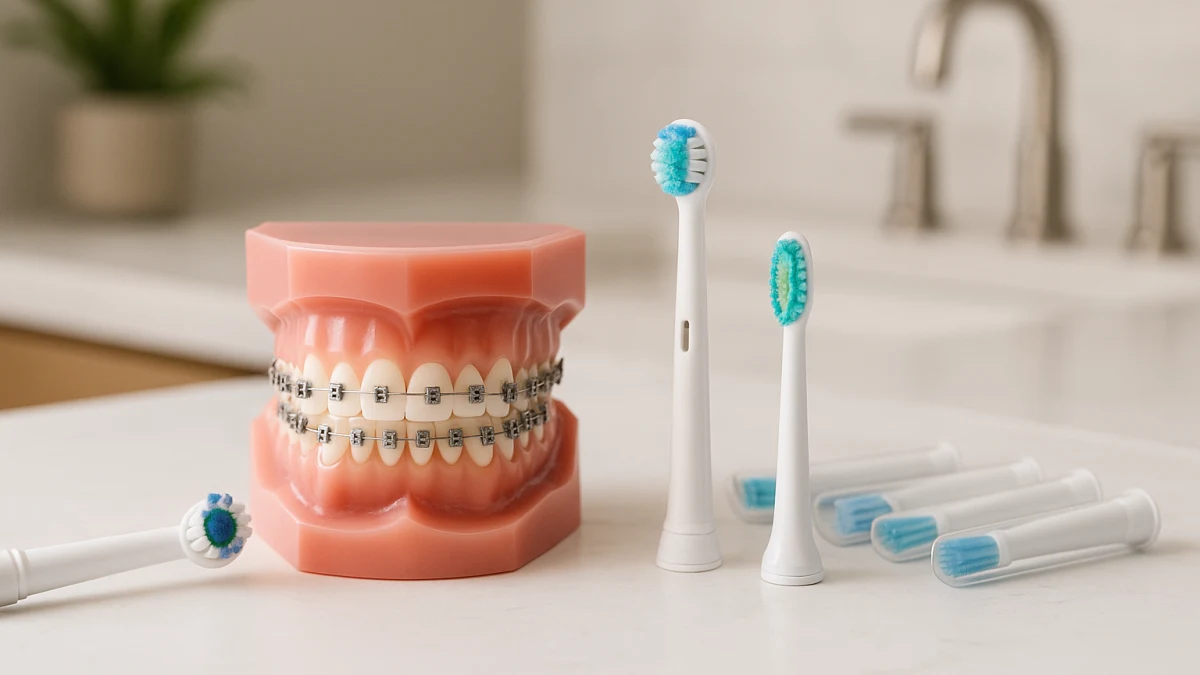
Use this collection to sort electric toothbrushes by bracket access, brush-head compatibility, and comfort features instead of treating every electric toothbrush listing as interchangeable. A normal category page may put timers, whitening claims, sonic speed language, travel cases, and replacement heads next to each other without explaining which details matter around brackets, wires, and the gumline.
Braces change the order of the decision. This page starts with compact round-head options because those listings more often show Oral-B, iO, rotating, round-head, or compatible-head wording. Sonic options are included only when the listing gives a braces, dental-braces, soft-bristle, W-shaped, U-shaped, or orthodontic-compatible reason to consider them. Gentle modes and pressure sensors come later as helpful extras, not as substitutes for brush-head access or orthodontic instructions.
Choose by head access before brushing extras
| If this is your main need | Better fit |
|---|---|
| You want to place the brush carefully around individual brackets, wires, and the gumline. | Small-head oscillating electric toothbrushes |
| You prefer a lighter sweeping motion but still want visible braces, dental-braces, soft-head, W-shaped, U-shaped, or orthodontic-compatible wording. | Sonic electric toothbrushes with slim or orthodontic-compatible heads |
| Your teeth feel tender after adjustments and you want lower-intensity brushing cues. | Use pressure-sensor or gentle-mode electric toothbrushes only after choosing a braces-access head style. |
| The product is mainly a water flosser, interdental brush, orthodontic wax, whitening-light device, or flossing product. | Skip it for this collection; those products are outside the electric toothbrush decision. |
Before comparing modes, compare four things: the brush-head footprint, the replacement-head fit, any braces-specific wording on the listing, and then comfort supports such as pressure sensors, gentle modes, timers, quadrant reminders, or 30-second reminders.
Start with bracket access, not extra modes
A good first filter is simple: can you picture the brush head being positioned around brackets, wires, and gumline areas without relying on broad brushing claims? Compact round heads, slim sonic heads, W-shaped heads, and U-shaped head options all belong in the conversation only because of access and fit.
Use this order when scanning the products shown here:
- Check the head style first: round, rotating, Oral-B-style, iO-style, slim sonic, W-shaped, U-shaped, or orthodontic-compatible.
- Check the handle family next: Oral-B iO and Oral-B Pro/Genius/Smart Series can point to different refill paths.
- Treat braces, dental-braces compatibility, soft bristles, and orthodontic-compatible head wording as more relevant than generic whitening or speed language.
- Put timers, pressure sensors, gentle modes, sensitive modes, and travel cases in the secondary column.
What product listings can and cannot prove about braces
Product listings can help you compare visible features: head shape, handle family, included replacement heads, soft bristles, timers, pressure sensors, and named compatibility. They cannot, by themselves, prove braces-specific clinical performance just because they mention plaque removal, whitening, or high-speed brushing.
For this page, broad cleaning percentages and generic oral-care claims are treated as general product language unless the listing or an authoritative source specifically connects them to braces. If your orthodontist or dentist has given you brushing, flossing, or interdental-cleaning instructions, use those instructions as the higher priority.
Outside this collection: flossers, wax, and treatment advice
This collection is only for electric toothbrushes. It does not cover water flossers, separately sold interdental brushes, orthodontic wax, whitening-light devices, flossing products, or professional orthodontic treatment advice.
Also skip any product that implies a toothbrush replaces flossing, interdental cleaning, or instructions from an orthodontic professional. Those may be important parts of braces care, but they are not the same shopping decision as choosing an electric toothbrush handle and compatible brush heads.
Compact round heads for bracket-by-bracket placement
This is the main path if you want controlled placement around individual brackets, wires, and gumline areas. Look for listings that visibly say Oral-B, iO, rotating, round-head, or compatible replacement heads. Those details are useful because they tell you more about the head family than a generic electric toothbrush description does.
Handle-family fit matters here. An Oral-B iO listing and an Oral-B Pro/Genius/Smart Series listing may not point to the same replacement heads, so do not treat the handle name as a small detail. If the product includes extra heads or a travel case, count that as ownership convenience; the decision anchor is still round-head access and the refill path.
Timers, quadrant reminders, pressure sensors, gentle modes, and sensitive modes can support brushing habits, but they do not prove that one round-head brush cleans braces better than every sonic option. Use them after you have checked head shape and compatibility.
Read this shelf by handle family first, then by the head and refill information shown on the product page. If you prefer a sweeping brushing motion and the listing clearly mentions braces, dental-braces compatibility, or a braces-relevant head shape, the sonic lane may be worth checking next. If that wording is missing, the compact round-head lane is usually the clearer comparison path on this page.
Round-head access is not the same as an orthodontic head
A compact round head can be a useful access clue, but it is not automatically an orthodontic replacement head. Oral-B, iO, rotating, and round-head wording helps you compare placement, yet it does not guarantee that a specific braces-focused refill is included or compatible.
Before buying, look for the exact handle family and the exact replacement-head names. If you need an orthodontic-compatible head, the product page should say which head fits that handle. Do not assume that an iO-compatible head fits a Pro, Genius, or Smart Series handle unless the listing says so.
Sonic options with explicit braces or slim-head signals
Choose this lane if you prefer a sonic brushing style but still want a listing that gives a braces-relevant reason to consider it. Stronger details include braces or dental-braces compatibility, soft bristles, W-shaped heads, U-shaped head options, orthodontic-compatible replacement heads, or head shapes meant to follow tooth contours. Generic sonic speed language is not enough for this collection.
This is a narrower shelf than the round-head section. Compare head style, bristle softness, included heads, refill intervals, timers, and any pressure-sensor details, then verify that replacement heads are available for the handle. If a sonic listing mainly talks about whitening, speed, or travel accessories without braces or head-shape wording, it is a weaker fit here.
Keep tender-day comfort features in a secondary lane
Tenderness after adjustments can make gentle, sensitive, soft, or super-sensitive modes appealing, and pressure-sensor feedback may help you notice brushing force. Those are useful refinements, not the main reason a toothbrush belongs on a braces-focused page.
Keep the order straight: first choose a head style that can be positioned around braces hardware, then confirm the refill path, then compare comfort features. A sensitive mode does not confirm braces compatibility by itself.
Comfort filters for tender adjustment days
Use this section only after you have narrowed the head-access choice. Look for pressure-sensor, gentle, sensitive, soft, or super-sensitive features, plus soft-tapered bristles, W-shaped brush heads, timers, 30-second reminders, and included replacement heads when those details support the broader fit decision.
Read these products as a comfort and feedback shelf. They may help you compare lower-intensity modes or brushing reminders for tender days, but do not choose a toothbrush only because it has a pressure sensor if the head style or replacement-head fit is unclear. If comfort is your main concern beyond product features, follow guidance from your dental or orthodontic professional.
Refill-head checks before choosing a braces toothbrush
Before committing to a handle, make the refill path as clear as the toothbrush itself:
- Identify the exact handle family, such as Oral-B iO, Oral-B Pro/Genius/Smart Series, or the specific sonic handle line.
- Confirm which replacement heads fit that handle; similar-looking heads are not always interchangeable.
- Check whether included heads are the same type you plan to keep using later.
- If the listing mentions W-shaped, U-shaped, soft, or orthodontic-compatible heads, verify that those heads are available as refills.
- Treat travel cases, displays, timers, brushing scores, and extra modes as secondary to head access and refill compatibility.
- Keep following flossing, interdental-cleaning, and orthodontic instructions; an electric toothbrush does not replace those steps.
Choose the brush head and compatible refill path first. Then use timers, pressure sensors, gentle modes, and included heads as helpful extras for day-to-day brushing around braces.