
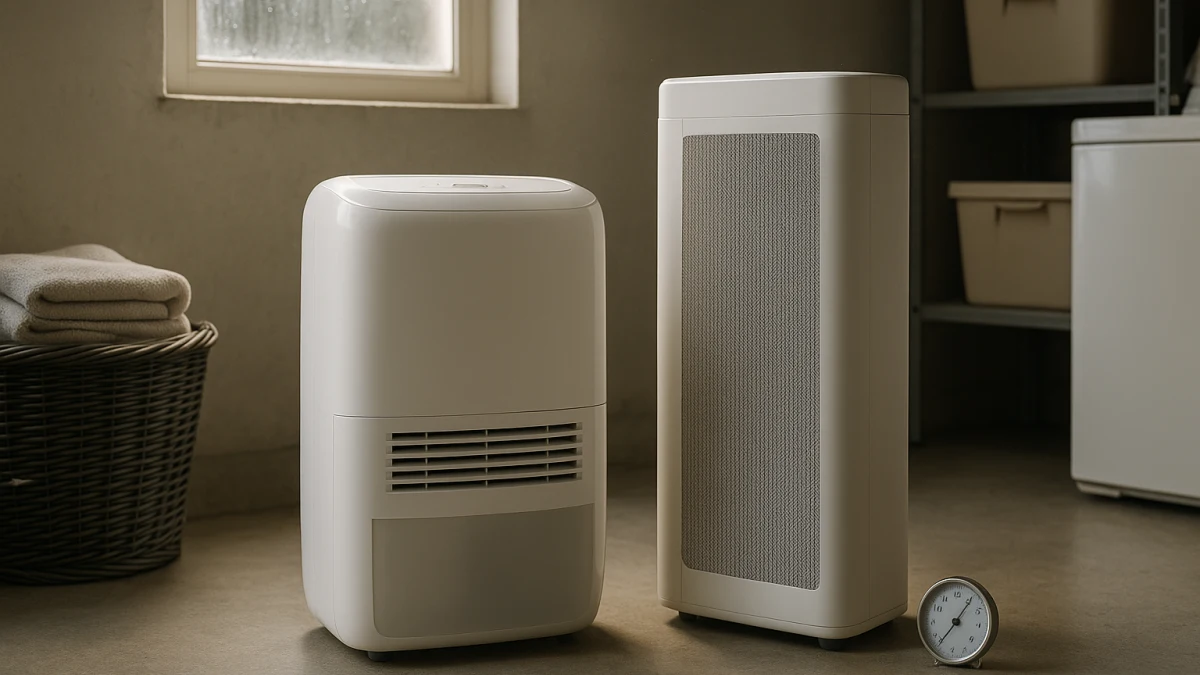
A musty room should not automatically send you to the air-purifier aisle. Mustiness is often a clue that moisture needs attention first. If the room feels damp, shows condensation, stays humid after laundry or wet weather, or has basement-like conditions, start with moisture control and the source of the dampness. If the room is dry and the main problem is smoke, dust, pollen, pet dander, airborne particles, or an odor that remains after its source has been addressed, an air purifier is the more relevant product type.
This collection separates those two jobs. Dehumidifiers are compared by moisture-removal capacity, drainage, humidity control, operating temperature, and day-to-day handling. Air purifiers are compared by particle filtration, CADR, room fit, carbon filtration, sensors, noise, and filter ownership costs. Humidity monitors sit beside the decision as diagnostic tools. Humidifiers generally point in the opposite direction and should not be used to solve a damp, musty-room problem.
Start with the moisture source, not the smell
| What you notice in the room | Better first step |
|---|---|
| The room feels clammy, has condensation, repeatedly high relative humidity, damp laundry conditions, or basement-like mustiness. | Address the moisture source, then compare dehumidifiers if active humidity removal is still needed. |
| The room is dry, but the main concern is smoke, dust, pollen, pet dander, PM2.5, or other airborne particles. | Air purifier path |
| Moisture is now controlled, but airborne particles or residual odor remain. | Consider an air purifier as a complementary second step. |
| You are not sure whether humidity is actually high. | Check relative humidity with a hygrometer or air-quality monitor before choosing a treatment device. |
| There is a leak, seepage, wet material, recurring condensation, or visible mold growth. | Fix the moisture problem and handle cleanup or remediation first; neither appliance is a substitute. |
The key distinction is function. A dehumidifier removes water from indoor air. An air purifier moves air through filters or other cleaning stages to reduce certain airborne contaminants. One does not replace the other.
As a useful moisture-control reference, indoor relative humidity is generally kept below 60%, with roughly 30–50% often used as a practical target where conditions allow. A single reading is not enough to diagnose a building problem, but repeated high readings together with condensation or damp surfaces are strong reasons to investigate moisture before shopping for filtration.
Mustiness can be a moisture warning
A room can smell musty before obvious water damage appears. Check windows, exterior walls, corners, closets, basement surfaces, laundry areas, and other places where moisture can collect. Also consider whether the smell becomes stronger after rain, showering, clothes drying, or periods when ventilation is limited.
If you find an active moisture source, source control comes first. A dehumidifier can help lower humidity after or alongside appropriate moisture control, but it cannot repair a plumbing leak, stop groundwater intrusion, waterproof a wall, dry inaccessible building materials automatically, or remove established mold from a surface.
An air purifier has a different limitation: it does not lower relative humidity. Particle filters may capture some airborne particles, including material that becomes airborne from a contaminated area, but that does not remove the source on a wall, floor, ceiling, furnishing, or other material.
Moisture-first lane: dehumidifiers for damp rooms
Choose this lane when the room feels damp or repeatedly shows elevated humidity, especially in basements, garages, laundry areas, or other spaces where moisture accumulates.
Start with actual water-removal capacity, usually stated in pints per day in U.S. listings or liters per day elsewhere. Compare capacities only when the test basis is reasonably comparable. Current U.S. DOE-rated capacities, older ratings, manufacturer-specific conditions, and values measured under warmer or more humid laboratory conditions can produce numbers that look similar while describing different performance.
Do not confuse full-size room dehumidifiers with very small thermoelectric or Peltier units. A compact closet or desktop device may remove far less water per day even when its listing uses broad room-size language. Check the stated daily extraction rate rather than relying on words such as “large room,” “basement,” or “high efficiency.”
After capacity, compare the features that determine whether the unit can manage moisture continuously:
- humidistat or selectable target humidity;
- removable tank size and full-tank auto shutoff;
- gravity-drain support and whether a hose is included;
- built-in pump if water must be lifted to a sink or higher drain;
- automatic defrost and minimum operating temperature for cool basements or garages;
- noise level and fan-speed options;
- caster wheels, handles, and appliance weight;
- restart behavior after a power interruption;
- smart controls or remote monitoring where useful;
- ENERGY STAR certification or other relevant efficiency information where available.
Drainage deserves more attention than tank size alone. Continuous gravity drainage can remove the need for regular bucket emptying, but the drain normally needs to be lower than the outlet. A pump-equipped model can be more useful when water must travel upward.
Temperature also matters. Compressor-based dehumidifiers can behave differently in a cool basement or garage than in a warm room, so check the manufacturer's operating-temperature range and defrost behavior rather than choosing only by advertised square footage.
Confirm that humidity is actually coming down
A humidity display is useful when it helps answer a specific question: is the room staying within the target range after the moisture source has been addressed and the dehumidifier has been running?
A separate hygrometer can also help because built-in sensors sit inside or near the appliance and may not represent conditions everywhere in the room. In larger or divided spaces, readings from another part of the room can provide useful context.
If humidity remains high despite continuous operation, do not automatically solve that by adding an air purifier. Check whether the dehumidifier is undersized, whether doors or windows are bringing in humid air, whether drainage is working, whether the space is too cold for the unit, or whether an ongoing moisture source is overwhelming it.
Filtration lane: air purifiers after the moisture question is resolved
Choose an air purifier when the space is not actively damp and the problem is primarily airborne particles such as smoke, dust, pollen, pet dander, or PM2.5.
For particle filtration, CADR is one of the most useful comparison metrics when available. CADR describes the delivery of filtered air for particles; higher values generally mean faster particle removal in an appropriately sized room. AHAM Verifide models provide independently verified CADR values for smoke, dust, and pollen.
Room-size claims are less useful when viewed alone because manufacturers may calculate them using different air-change assumptions. A very large advertised coverage area can sometimes describe only one air change over a long period. When comparable CADR data is available, use it alongside the actual room dimensions rather than relying only on the largest square-foot number printed in a listing.
For the filter system, look for:
- a clearly specified particle filter, including HEPA filtration where offered;
- CADR values appropriate for the room;
- AHAM Verifide certification where available;
- a washable or replaceable pre-filter for larger debris;
- activated carbon or another gas-phase medium if odors or specific gases are part of the problem;
- replacement-filter availability and expected replacement intervals;
- operating noise at the speeds you are likely to use;
- automatic mode and PM2.5 or other particle sensors where useful;
- smart controls if remote monitoring or scheduling matters.
CADR is a particle-cleaning metric. It should not be interpreted as an odor or VOC-removal rating.
Activated carbon belongs to the gas and odor side of the comparison, but the presence of a thin carbon sheet or the words “activated carbon” does not guarantee strong removal of every odor or VOC. Performance depends on the pollutant, the amount and type of sorbent material, airflow, saturation, and replacement schedule. Check the manufacturer's specific claims rather than assuming that any carbon stage will eliminate mustiness.
Likewise, a VOC sensor reports conditions; it does not prove that the purifier has enough gas-phase media to remove the compounds it detects.
HEPA filtration does not solve dampness or mold growth
HEPA filtration is relevant to airborne particles, not moisture removal. If a musty room still has wet materials, recurring condensation, or visible mold, filtration should not become a substitute for correcting those conditions.
An air purifier may be useful later for airborne particles after the moisture source and any required cleanup have been handled. It should not be marketed or purchased as a device that removes mold growing on surfaces, dries walls, stops a leak, or prevents recurrence while the moisture source continues.
The same distinction applies to odor. If an odor has a continuing source, removing or controlling that source is more important than repeatedly filtering the air around it.
Where monitors, ventilation, and humidifiers fit
A humidity monitor or hygrometer can help decide whether a musty room actually belongs in the dehumidifier lane. An air-quality monitor may also track PM2.5, VOC estimates, CO2, temperature, or humidity depending on the model. These are measurement tools, not treatment devices.
If a room is described as “stale” mainly because it feels stuffy or has elevated CO2 from occupants, an air purifier is not a substitute for appropriate ventilation. Typical particle filters do not remove CO2.
Humidifiers generally belong to a different problem entirely. They add moisture to indoor air, so they are usually the wrong direction when the room already has condensation, high relative humidity, damp materials, or basement-like mustiness. Aroma diffusers and essential-oil products also do not substitute for moisture removal, source control, or particle filtration.
Common musty-room shopping mistakes
- Buying an air purifier before checking for moisture. HEPA, CADR, carbon filters, and PM2.5 sensors do not mean a product can dry the room.
- Using a dehumidifier as leak repair. Lowering airborne humidity does not stop water intrusion or repair wet building materials.
- Comparing dehumidifiers only by advertised room size. Check daily extraction capacity, rating conditions, room temperature, drainage, and humidity controls.
- Comparing tiny thermoelectric units with compressor dehumidifiers as if they perform the same job. Use actual water-removal capacity to understand the difference.
- Buying an air purifier only by its largest coverage number. Look at CADR and the assumptions behind room-size claims when those details are available.
- Treating HEPA and activated carbon as interchangeable. HEPA is primarily for particles; carbon or other gas-phase media addresses certain gases and odors.
- Assuming a sensor is a treatment feature. PM2.5, VOC, CO2, temperature, and humidity sensors measure conditions; they do not by themselves remove the pollutant being measured.
- Expecting carbon to eliminate every musty odor. Persistent odor can indicate a continuing source that should be found and addressed.
- Adding moisture to an already damp room. Humidifiers, misting devices, diffusers, and aromatherapy products are not fixes for moisture-related mustiness.
- Treating either appliance as mold remediation. If mold is present, deal with the moisture source and the contaminated material rather than relying on an appliance to make the underlying problem disappear.
The practical buying order is source first, function second. If the room is genuinely damp, correct the moisture problem and use a properly sized dehumidifier when active humidity removal is needed. If the room is dry and the remaining problem is airborne particles or an odor that a suitable gas-phase filter can address, compare air purifiers. In some rooms both devices can eventually be useful, but they are solving different parts of the problem.