
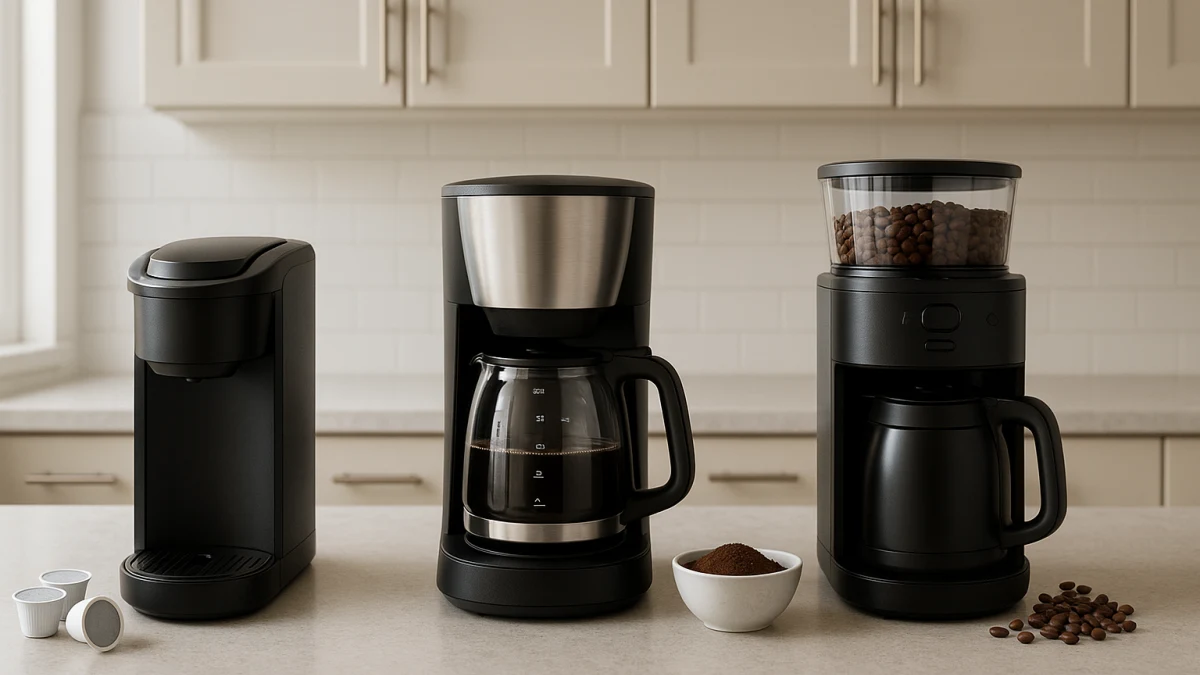
Coffee maker listings often mix K-Cup pods, capsules, reusable filters, carafes, ground coffee, and built-in grinders into one long feature list. A better first question is what you expect to load into the machine most mornings: portioned pods or capsules, bagged ground coffee, or whole beans.
Use this page as a format check before comparing individual models. The three paths differ in serving style, recurring supplies, cleanup, counter space, and how much control you have over the coffee itself. Some machines support more than one input, so treat the sections as primary-use paths rather than mutually exclusive categories.
Pick by the coffee format you will actually use
| If this sounds like your morning | Better fit |
|---|---|
| You usually want one cup at a time with minimal measuring and are comfortable buying a specific pod or capsule format. | Pod-compatible single-serve coffee maker |
| You buy bagged ground coffee, want a carafe or several cups at once, and prefer a conventional filter basket. | Ground-coffee drip or programmable coffee maker |
| You buy whole beans and want grinding integrated into the brewer instead of using a separate grinder. | Whole-bean grind-and-brew coffee maker |
| You specifically want Nespresso Original, Vertuo, espresso extraction, a steam wand, or a portafilter. | Verify the machine type separately; those requirements are more specific than general pod, drip, or grind-and-brew compatibility. |
| A listing says reusable filter and you are trying to determine whether it accepts K-Cup pods. | Do not infer compatibility from that phrase alone; verify exactly what the reusable filter is designed for. |
Start with your primary coffee routine
- Choose the pod or capsule path if portioned single cups and low preparation effort are the priority.
- Choose the ground-coffee path if you want broad access to bagged coffee, batch brewing, or a traditional carafe routine.
- Choose the whole-bean path if grinding immediately before brewing matters enough to justify additional grinder components and maintenance.
- If a machine supports two formats, decide which one you expect to use most often. Secondary compatibility is useful, but it should not distract from the routine that determines most of your cost and cleanup.
K-Cup pods, capsules, reusable filters, and grinders are not interchangeable terms
Compatibility language needs careful reading.
K-Cup normally refers to the Keurig-style K-Cup pod format, but that does not mean the machine accepts Nespresso capsules or other capsule systems. Likewise, a listing that simply says capsule should not be treated as compatible with every capsule brand or size.
The phrase reusable filter is especially ambiguous. On a drip brewer it can mean a permanent basket filter for loose ground coffee. On some single-serve machines, sellers may use similar wording for a reusable K-Cup-style filter or refillable pod. The product page should identify the actual part and coffee format.
Grinder wording also needs a boundary. For this page, the whole-bean path means a coffee maker with a built-in or integrated grinder. A standalone coffee grinder is a different purchase, and an espresso machine with an integrated grinder belongs to a more specific espresso comparison.
Compatibility claims to verify before buying
For pod and capsule machines, check:
- The exact supported pod or capsule system.
- Whether the machine also accepts loose ground coffee.
- Whether a reusable pod or refillable filter is supported.
- Brew-size options and mug clearance.
- Whether any required adapter is included or sold separately.
For drip machines, check:
- Carafe capacity.
- Basket and filter type.
- Whether paper filters are required, optional, or unnecessary.
- Programmable start, warming, and automatic shut-off functions if you need them.
For grind-and-brew machines, check:
- Grinder type and available grind settings.
- Bean hopper capacity.
- Whether pre-ground coffee can also be used, if that matters to you.
- Access to the grinder and coffee path for cleaning.
- Manufacturer instructions for descaling and grinder maintenance.
If a material claim such as BPA-free construction matters to you, verify the manufacturer's specification for the relevant food-contact components rather than assuming it from category wording.
Pod-compatible single-serve coffee makers for quick individual cups
This path is primarily about portioned brewing. Look for explicit compatibility wording such as K-Cup pod, coffee pod, capsule, refillable pod, or a named capsule system, then verify the exact format on the product page.
Single-serve machines can vary substantially. Some accept only one proprietary format. Others accept K-Cup-style pods plus loose grounds through a separate reusable filter. Some offer several cup sizes or enough mug clearance for a travel cup, while others are designed around smaller servings.
Compare these products by exact compatibility first, then by brew sizes, reservoir capacity, reusable-ground-coffee options, and cleaning requirements. If you routinely want several cups at once, a carafe-style drip brewer is usually the more relevant comparison.
Reusable filter does not prove pod compatibility
Do not use the phrase reusable filter as a shortcut for identifying machine type.
A permanent mesh basket in a drip brewer is a reusable filter. A refillable insert for a compatible single-serve brewer may also be described as a reusable filter. Their function, dimensions, and compatibility are completely different.
If pod support matters, look for explicit wording such as K-Cup compatible, pod compatible, reusable pod, or the name of the supported capsule system.
Ground-coffee drip brewers for carafes, timers, and batch brewing
This is the conventional route for bagged ground coffee. It fits shoppers who want a carafe, several cups in one brewing cycle, a familiar filter basket, or features such as programmable start and a warming plate.
Capacity deserves closer attention here than in most single-serve comparisons. Small drip machines may be designed around compact 4- or 5-cup carafes, while larger models may advertise 10-, 12-, or 14-cup capacity. Coffee-maker "cups" are manufacturer-defined serving units and can be smaller than a typical drinking mug, so compare the stated carafe volume when actual output matters.
Filter systems also differ. A machine may include a permanent filter, use disposable paper filters, or support both. Programmable brewing, warming time, brew-strength controls, and automatic shut-off are similarly model-specific rather than guaranteed drip-brewer features.
Use these products to compare carafe capacity, filter setup, controls, and counter footprint. Choose this path when ground coffee and batch brewing are central to the purchase rather than occasional fallback features.
Cleanup changes when you add a built-in grinder
A conventional drip brewer usually concentrates routine cleanup around the carafe, brew basket, filter, and water system.
A grind-and-brew machine adds components that handle whole beans and freshly ground coffee. Depending on the design, that can include a hopper, grinder, chute, or other parts where coffee particles and oils accumulate.
Integration can save the counter space occupied by a separate grinder, but it does not necessarily make the overall system simpler. Check the cleaning procedure before buying, especially if grinder access is limited or parts cannot be removed easily.
Grind-and-brew coffee makers for whole-bean routines
Use this path when the listing explicitly combines brewing with a built-in grinder, integrated grinder, burr grinder, grind settings, or Grind & Brew functionality.
The main advantage is workflow: beans can be ground as part of the brewing process without a separate appliance. That can shorten the time between grinding and brewing, although the final cup still depends on the beans, storage, grind configuration, water, brew settings, and machine design.
Compare these products by grinder design, grind adjustment, hopper capacity, carafe or serving format, pre-ground bypass support if offered, and access for cleaning. If you normally buy pre-ground coffee and do not expect to switch to whole beans, a standard drip brewer avoids paying for and maintaining grinder hardware you may rarely use.
Recurring cost and storage are part of the format decision
The machine price is only one part of the choice.
Pod and capsule systems create an ongoing supply of individually portioned coffee and require storage for those portions. Compatibility can also tie you to a particular pod ecosystem unless the machine supports refillable options.
Ground-coffee machines give you broad access to bagged coffee but may require paper filters depending on the brewer. You also need space for the coffee bag, filters if used, and the carafe.
Whole-bean machines require bean storage and add grinder maintenance. They can replace a separate grinder, but the integrated mechanism becomes another part of the coffee maker to keep clean and eventually service.
Format-lock checklist for pods, grounds, and whole beans
Before you buy, check:
- Your primary coffee input: pod, capsule, loose ground coffee, or whole beans.
- The exact pod or capsule system rather than generic compatibility wording.
- Whether secondary inputs such as loose grounds or reusable pods are actually supported.
- Brew sizes and mug clearance for a single-serve machine.
- Carafe volume for drip and grind-and-brew machines.
- Filter type and whether replacement or paper filters are required.
- Programmable start, warming, brew-strength, and automatic shut-off features if they matter to your routine.
- Grinder type, grind adjustment, hopper design, pre-ground support, and cleaning access on grind-and-brew models.
- Water-reservoir access and capacity.
- Descaling and other maintenance instructions from the manufacturer.
- Ongoing storage space for pods, capsules, ground coffee, beans, filters, and removable machine parts.
Choose the coffee format and serving routine first. Then compare machines within that path by exact compatibility, capacity, controls, cleanup, recurring supplies, and maintenance rather than treating every coffee-related feature in a listing as interchangeable.