
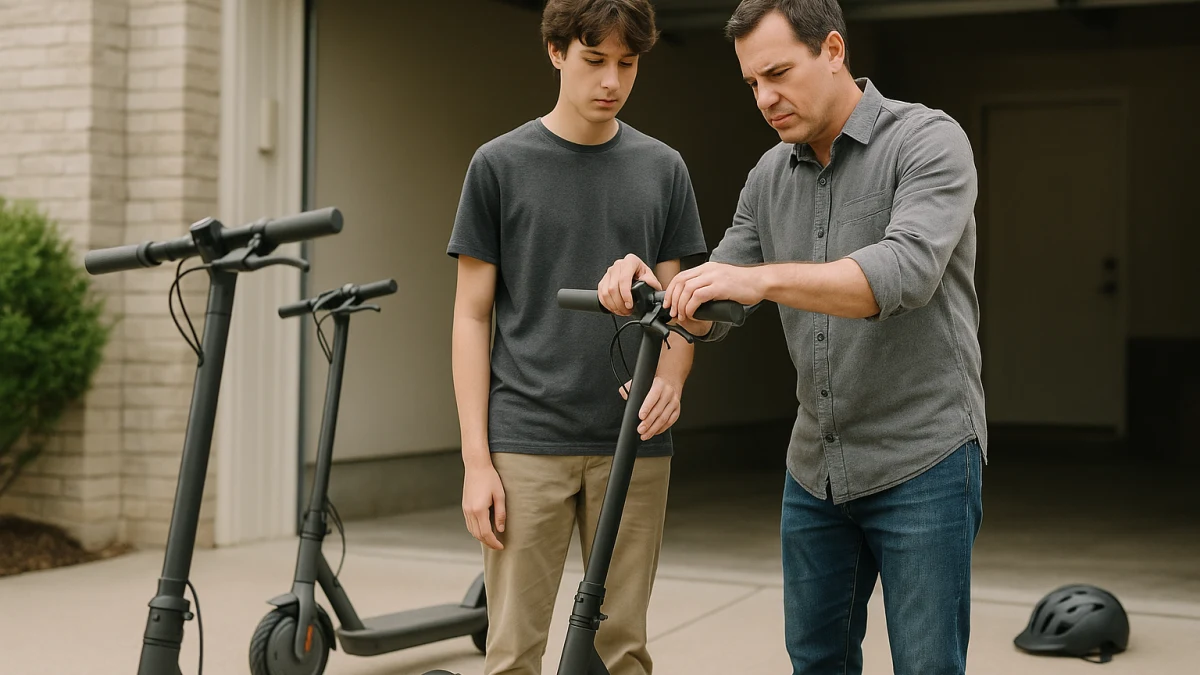
An electric scooter for an older teen is not a toy purchase, and a marketplace label such as Teen or Adult is not enough to establish that a model is appropriate. For this collection, treat an older teen as a 16- or 17-year-old rider. If the rider is younger than 16, do not use this page as a shortcut to a purchase decision; check current pediatric safety guidance, manufacturer age limits, and local rules first.
For a 16–17-year-old, start with four gates before comparing price or advertised top speed: manufacturer age guidance, physical fit, controllability, and where the scooter may legally and practically be ridden. A listing that advertises about 19 MPH, a high rider-weight limit, Bluetooth, or commuter styling can still fail one of those gates.
Start with manufacturer age guidance, not the Teen or Adult label
The strongest first filter is the manufacturer’s documentation for the exact model. Look for a minimum age, recommended age range, intended-rider wording, or an age restriction in the manual.
Use marketplace attributes such as Adult, Adults/Teens, or Teen only as discovery signals. They can be incomplete, generalized, or inconsistent with the manufacturer’s own instructions.
For a 16- or 17-year-old:
- If the manufacturer explicitly limits the scooter to riders 18 and older, remove it from the shortlist.
- If the manufacturer gives a minimum age that includes the rider, continue to the fit and control checks.
- If no reliable age guidance is visible, look for the official product page or manual before treating the scooter as suitable.
- Do not substitute a high weight limit for an age recommendation.
This matters especially with commuter-style scooters. A model can physically support a teenager while still being designed and documented only for adults.
Check rider fit before comparing a 19 MPH top-speed claim
After age eligibility, compare the dimensions that determine whether the scooter is manageable for the specific rider.
Useful fields include:
- maximum rider weight;
- handlebar height or adjustable-height range;
- deck dimensions where available;
- wheel or tire size;
- scooter dimensions;
- scooter weight;
- folded dimensions if it will be carried or stored;
- handlebar and stem design.
A rider being below the maximum weight limit proves only that the stated load capacity is not exceeded. It does not prove comfortable reach, good steering leverage, manageable scooter weight, or easy carrying on stairs and public transport.
A particularly heavy commuter scooter may be reasonable once moving but impractical for a student who must lift it regularly. Likewise, an adult-sized fixed handlebar can be a poor fit even when the load limit looks generous.
Read the products shown here as fit candidates rather than universal teen recommendations. Keep a model only if the manufacturer’s age guidance and the actual dimensions make sense for the rider. If the product card is missing a critical age or size field, verify it from the manufacturer instead of inferring suitability from the frame size or advertised speed.
Treat advertised top speed as a limit, not a target
Once age and physical fit check out, look at how controllable the scooter is.
Listings around 19 MPH can sound moderate next to faster adult scooters, but the number should not be interpreted as a safe cruising recommendation for a teenager or a new rider. Advertised top speed also does not tell you how abruptly the scooter accelerates, how easy the lowest mode is to control, or how long the scooter takes to stop.
Compare:
- stated maximum speed;
- available riding or speed modes;
- whether the lowest mode meaningfully reduces speed or acceleration;
- throttle type and control layout;
- whether speed settings persist after the scooter is restarted;
- whether the rider can easily override an app-set limit.
If speed limiting is important to the parent, require an explicitly documented function that actually limits or locks speed. Bluetooth, an app, or a digital dashboard is not automatically a parental-control system.
The same rule applies to cruise control. Treat it as an operating feature, not a safety advantage. If the rider is inexperienced, check whether cruise control can be disabled and how the manufacturer says it should be used.
Brake labels are useful, but they are not stopping-distance proof
Brake terminology can help distinguish models, but labels such as dual braking, EABS, regenerative braking, drum brake, electronic brake, or disc brake should not be turned into a safety ranking by themselves.
Instead, verify:
- what brake acts on the front wheel;
- what brake acts on the rear wheel;
- whether the system combines mechanical and electronic braking;
- which control activates each brake;
- whether the manufacturer explains normal and emergency braking;
- whether replacement or adjustment information is available.
A product saying dual braking does not establish how quickly it will stop under real conditions. Rider weight, surface, tire condition, speed, brake adjustment, and the particular scooter all matter.
Before regular use, the rider should understand the controls and test the brakes at low speed in a safe area. A scooter that feels difficult to stop or control should not be made acceptable simply because its listing contains stronger-sounding brake terminology.
Use these products as a speed-and-control comparison, not a fastest-scooter ranking. A model that fails the manufacturer-age or physical-fit checks should stay off the shortlist regardless of motor power, app features, braking labels, or advertised top speed.
Verify UL 2272 correctly
For an electric scooter, electrical and battery safety deserves a separate check.
If a listing mentions UL 2272, verify that the claim applies to the exact scooter model rather than assuming that a generic UL logo, a charger certification, or vague language such as tested to UL standards means the entire scooter has the relevant certification.
Prefer documentation that lets you confirm the certification through the manufacturer or the recognized testing organization responsible for it.
Also keep the scope in perspective: UL 2272 addresses the electrical system of personal e-mobility devices. It is an important electrical and fire-safety signal, but it does not prove that a particular rider can control the scooter safely, that its stopping distance is appropriate, or that the scooter is legal for a teenager to ride in a particular place.
Include the charger and battery in the purchase decision
Do not evaluate only the scooter itself. The battery and charging setup are part of the product.
Before buying, confirm that:
- the scooter comes with the correct manufacturer-specified charger;
- replacement chargers and batteries, if needed later, have a clear manufacturer-approved path;
- the battery has not been modified or rebuilt by an unknown seller;
- charging instructions are available;
- the exact model is not subject to an active safety recall.
Avoid turning a cheap replacement or generic universal charger into the solution for a missing original charger. For normal ownership, follow the manufacturer’s charging instructions, use the supplied or specifically approved charger, and do not charge the scooter while everyone is asleep or when nobody can respond to a problem.
A helmet is a safety requirement, not just a legal checkbox
Local helmet laws can vary, but the purchasing decision should not depend on whether a particular jurisdiction legally requires one. Plan for the rider to wear a properly fitted helmet on every ride.
The same applies to basic riding behavior. A suitable scooter still requires:
- one rider only;
- both hands available for control;
- no phone use or other riding distractions;
- no riding under the influence of alcohol or drugs;
- a pre-ride check of tires, handlebars, stem, throttle, brakes, lights, cables, and frame;
- slower riding around pedestrians, vehicles, poor surfaces, cracks, and other obstacles.
Those checks matter because scooter suitability is not established at checkout. Condition and rider behavior continue to affect safety after purchase.
School, campus, sidewalk, bike-lane, and road access are separate checks
Do not treat intended use such as school commute or campus travel as a product specification.
Before buying, verify the rules that apply where the scooter will actually be used. Depending on the location, relevant questions can include:
- minimum rider age;
- helmet requirements;
- whether electric scooters are allowed on sidewalks;
- whether they may use bike lanes or roads;
- local speed restrictions;
- school or campus riding policies;
- whether the scooter may be brought inside a building;
- battery charging or storage restrictions.
A manufacturer can tell you how the scooter is designed. It cannot make the scooter legal on a particular sidewalk, permitted by a school, or acceptable for indoor charging on a campus.
Final parent check for an electric scooter for a 16–17-year-old
Before following an affiliate link and buying, make sure all of these answers are clear:
- Age: The manufacturer’s guidance includes the rider; a model marked 18+ is excluded.
- Fit: Rider weight, handlebar dimensions, scooter size, and scooter weight are manageable for the specific teen.
- Speed: The advertised top speed is understood as a maximum, and useful lower-speed modes are documented.
- Controls: Throttle, riding modes, and any speed-limiting function are clearly explained.
- Brakes: The actual braking system is documented rather than judged only from terms such as dual braking or EABS.
- App features: Bluetooth or app support is not being mistaken for parental control.
- Electrical safety: Any UL 2272 claim is verified for the exact model and understood as electrical-system certification rather than a rider-safety guarantee.
- Battery and charger: The correct charger is included or clearly specified, and replacement parts have a legitimate manufacturer-approved path.
- Recall status: The exact model has been checked for current safety recalls.
- Helmet: A properly fitted helmet is part of every ride, regardless of whether local law makes it mandatory.
- Ride location: Local and institutional rules have been checked for the places where the teen will actually ride, park, store, and charge the scooter.
Only compare price, range, styling, and convenience after those gates are passed. For an older teen, the better electric scooter is not the one with the most impressive 19 MPH-style specification sheet; it is the one whose age guidance, physical fit, controls, braking documentation, electrical safety, and intended riding environment all make sense for the same rider.