
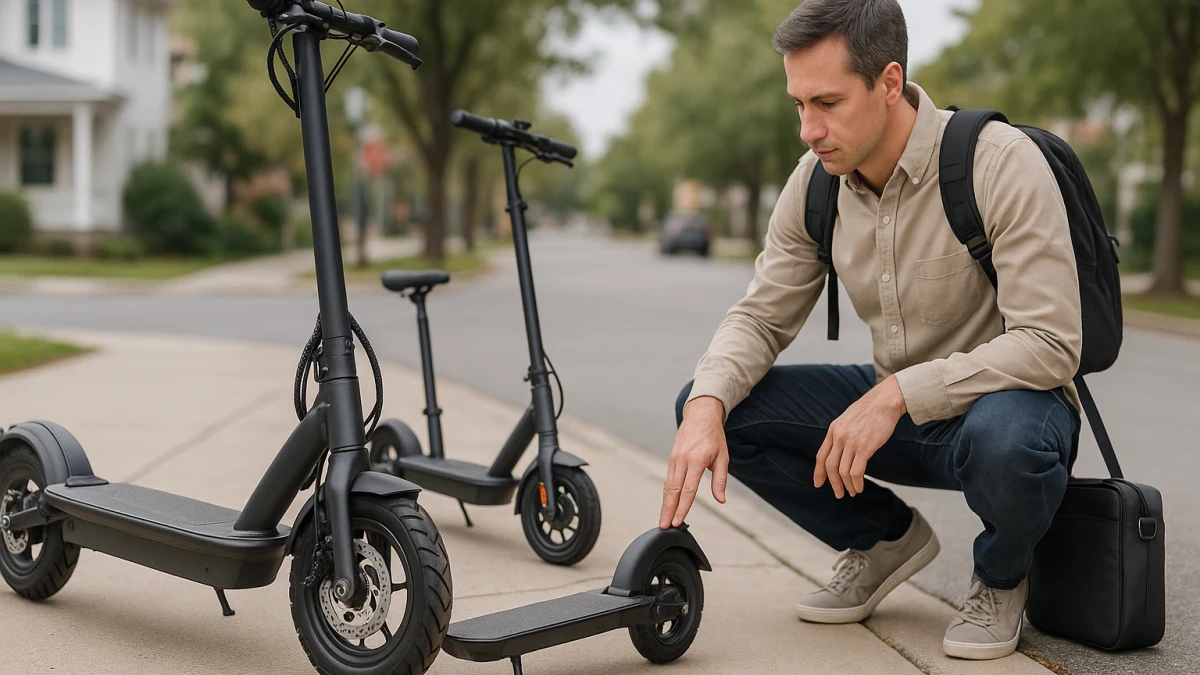
This collection is organized around one decision most scooter listings do not make clear enough: total carried load. A normal adult electric scooter category can mix 220 lb, 264 lb, 300 lb, and 330 lb models side by side, even though the rider, backpack, lock, cargo, and work gear all count against the listed limit.
The comparison here is intentionally uneven. The main set focuses on adult electric scooters with higher stated limits around 300 lb to 330 lb; the lower-limit scooters are included only as a boundary check for shoppers who are clearly within those limits. After capacity, use deck room, brake hardware, tire size, suspension, frame material, motor output, battery size, warranty language, portability, and advertised range as tradeoffs—not as excuses to ride above a stated limit.
Start with total carried load, not body weight alone
| If this is your situation | Better fit |
|---|---|
| Rider plus backpack, cargo, locks, or work gear points to a 300 lb or higher stated limit | Start with the high-capacity adult scooter section. |
| Total load is clearly below a 220 lb, 100 kg, 120 kg, 264 lb, or 265 lb listed limit, and portability matters | Use standard-capacity scooters only as boundary comparisons. |
| Total load is close to the listed limit or would exceed it with gear | Move up to a higher stated-capacity model instead of planning to ride above the limit. |
| You want more standing room and more visible braking hardware | Compare the high-capacity lane for items such as dual disc brakes, hydraulic disc brakes, deck width, 10-inch to 20-inch wheels, and suspension. |
Once the load number passes the first screen, compare the details that change daily use: deck width and body dimensions for room, brake type for hardware comparison, wheel size and tire type for ride feel, suspension for comfort, motor and battery specs for hill and range expectations, folding or item weight for portability, and warranty language for what the maker actually stands behind.
The load-limit screen: rider, backpack, lock, and work gear
Before comparing speed or advertised range, add up what the scooter will carry on a typical ride. A 210 lb rider with a loaded backpack, chain lock, laptop bag, groceries, or work tools is not shopping from the same load position as a 210 lb rider with empty pockets.
Use the listed maximum load as a hard shopping screen:
- If the total is above a scooter’s stated limit, skip that model.
- If the total is close to the limit, treat that as a reason to compare higher-capacity models first.
- If the total is comfortably below the limit, then deck room, brakes, tires, suspension, motor output, battery, folding design, and warranty language become the deciding details.
- Do not use advertised speed or range to override the maximum load.
Not mobility scooters, e-bikes, hoverboards, or above-limit shortcuts
This page stays inside adult electric scooters in the electric-scooter category. It does not cover medical mobility scooters, powered wheelchairs, e-bikes, mopeds, motorcycles, hoverboards, electric unicycles, kids scooters, or kick scooters.
It also does not treat a stronger motor, larger battery, suspension, or wider tires as permission to exceed a manufacturer-stated weight limit. Those features can help you compare adult electric scooters after the capacity screen, but they do not replace it.
What the scooter cards can prove—and what they cannot
The product cards can help you compare visible specifications: stated weight limit, deck width or body dimensions, brake type, tire size, tire type, suspension, frame material, motor output, battery information, warranty details, and advertised range.
They cannot, by themselves, prove real-world stopping distance, braking feel, long-term durability, or actual range for a heavier total load. Treat front and rear disc brakes, dual disc brakes, hydraulic disc brakes, electric braking, drum braking, and regenerative braking as hardware differences to inspect—not as a tested safety ranking.
Higher-limit adult scooters: 300 lb to 330 lb first
If your rider-plus-gear total calls for more capacity than a standard commuter scooter, start here. The products shown in this section are the main comparison set because they show higher stated limits such as 300 lb, 329.97 lb, or 330 lb.
Do not stop at the load number. Compare deck width, deck size, and overall dimensions for usable standing or seated room. Look at frame material where listed, then compare brake hardware such as front and rear disc brakes, dual disc brakes, electric braking, or hydraulic disc brakes. For ride comfort and stability comparisons, scan for 10-inch to 20-inch wheels, pneumatic tires, and suspension. Higher-output motors and larger batteries may be useful for hills and acceleration expectations, but advertised range can drop under heavier total load.
Read these products from left to right as a capacity-first shortlist, not as a simple speed contest. A scooter with a 330 lb limit but poor fit for your deck-room needs may still be wrong for you; a model with visible suspension and larger tires still needs its current maximum load, warranty language, and range assumptions checked on the product page before purchase.
The cutoff before looking at standard-capacity scooters
Lower listed limits are not automatically bad; they are just a different buying lane. A 220 lb, 100 kg, 120 kg, 264 lb, or 265 lb limit may be workable only when your full carried load remains within that number with room to spare.
This cutoff matters because standard-capacity scooters often advertise attractive commuter features—folding designs, lighter builds, 8.5-inch to 10-inch wheels, pneumatic or solid tires, disc or drum braking, regenerative or electric braking, and sometimes suspension. Those details can make them convenient, but they do not turn a lower-limit scooter into a higher-capacity pick.
Standard-capacity scooters: a cutoff check, not the main picks
Use this section only if your total carried load is clearly below the listed capacity. These products are useful for seeing what standard adult scooters look like in the catalog: lower maximum-load numbers, more portability-focused designs, and commuter-style wheels, tires, and braking hardware.
If a product here lists 220 lb, 100 kg, 120 kg, 264 lb, or 265 lb and your real total is close to that figure, move back to the higher-limit section. This lane is not a second set of heavier-rider recommendations; it is a comparison point for shoppers who are already under the lower stated limit.
Spec, warranty, and range checks for a higher total load
Before buying, check the current product page and manufacturer information for:
- The exact maximum load or weight limit, including whether it is shown in pounds or kilograms.
- Deck width, deck size, standing area, seat details if present, and overall dimensions.
- Brake hardware: disc, dual disc, front and rear disc, hydraulic disc, electric, drum, or regenerative braking.
- Tire size and tire type, including pneumatic versus solid tires.
- Suspension details, especially if comfort over rough pavement matters.
- Motor output and battery size, while remembering that they do not guarantee range under heavier load.
- Folding design, item weight, and carry practicality if you need to lift the scooter into a car, apartment, office, or transit setting.
- Warranty language that could affect coverage when the scooter is used near its stated capacity.
When braking confidence, range under load, or UL language needs proof
Be cautious with claims that sound more precise than the product card can support. Braking confidence, stopping distance, acceleration with heavier riders, real-world range under load, and long-term durability all need product-level support, testing, or clear manufacturer language.
The same goes for UL 2272-style wording or other certification language. If that matters to your purchase, verify the exact certification statement on the product page or manufacturer materials rather than assuming it from general scooter wording.
Choose the scooter whose current stated limit covers the rider plus gear first. Then use deck room, brake hardware, tires, suspension, portability, warranty language, and range expectations to narrow the field without relying on hype or above-limit promises.