
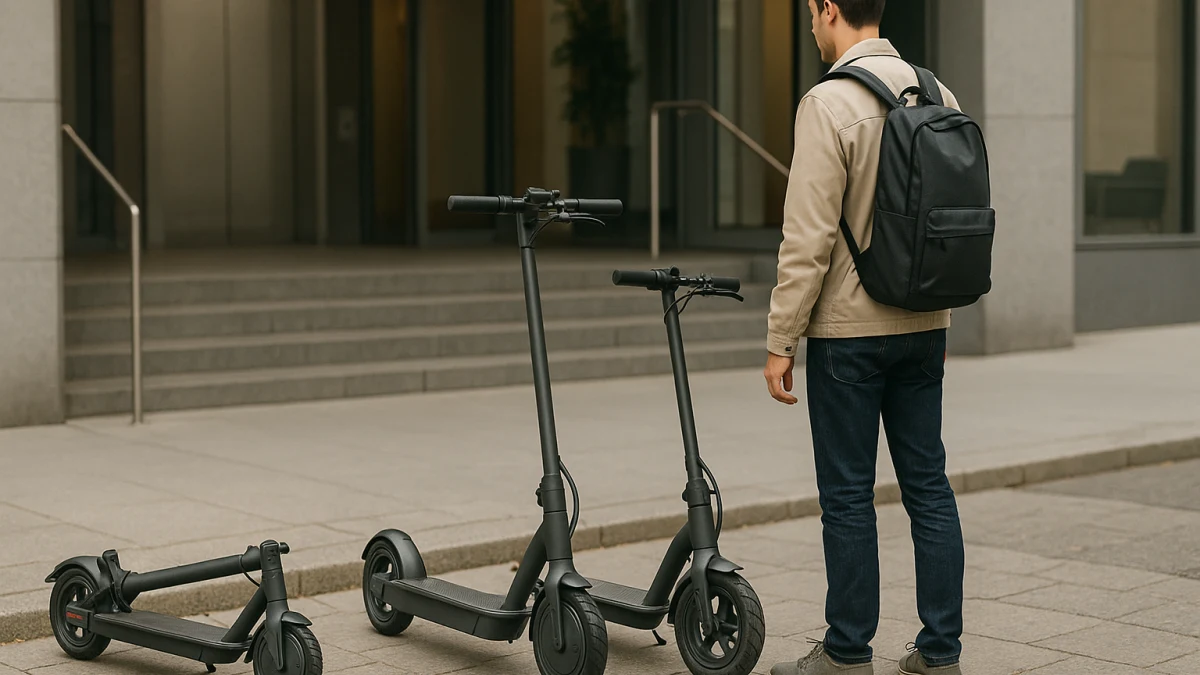
Most commuter-scooter mistakes happen when a shopper starts with the biggest number on the product card. A normal category page can show many electric scooters, but it usually does not separate the part of the commute that creates daily friction: carrying and storage, battery margin, or rough-route comfort.
The best fit is the scooter that works for the whole trip. More battery may help if your round trip leaves little cushion, but it can also mean more weight or bulk. A compact foldable model may be easier to store, but it may feel limiting on longer or rougher rides. Compare advertised range against your round trip, then check carried weight, folded size, charge time, tire type and size, braking, lighting, rider weight limit, and the tradeoff between comfort hardware and portability.
Choose by the commute problem that will annoy you every day
| If this sounds like your commute | Better fit to start with |
|---|---|
| You fold the scooter often, carry it up stairs, bring it onto elevators, or store it in an apartment or office. | Portable commuter electric scooters |
| Your round trip leaves too little battery margin on basic models or you want fewer charging sessions. | Longer-range commuter electric scooters |
| Your route includes rough pavement, longer ride time, or repeated daily use where tires, braking, deck comfort, and suspension matter. | Comfort-focused commuter electric scooters |
| You are comparing hoverboards for campus or neighborhood movement. | Treat hoverboards as a boundary case, not a commute-scooter substitute. |
Use this as a first cut, not a final answer. The same scooter can look good on range and still be awkward to carry; another can fold neatly but have tire, braking, or charge-time details that do not fit your routine.
Start with your commute limiter, not the biggest spec
Before comparing models, name the one thing that would make daily use frustrating:
- Handling problem: stairs, transit links, elevators, office storage, or a small apartment. Start with folding design, carried weight, folded size, and whether the scooter is genuinely practical to lift.
- Battery problem: a round trip that leaves too little cushion, detours, hills, or fewer chances to charge. Compare advertised range with charge time, battery setup, rider weight limit, brakes, lights, and motor information.
- Ride-feel problem: rough pavement or longer ride time. Look more closely at pneumatic tires, larger or wider tires, suspension, shock absorbers, disc brakes, lighting, and deck comfort.
- Access problem: road, sidewalk, campus, transit, or building rules. Do not infer permission from a product being marketed for commuting.
Keep hoverboards and other lookalikes out of the commuter-scooter decision
Hoverboards can be useful to compare only as a short-distance boundary case. They do not answer the same buying question as an adult electric scooter with a handlebar, folding hardware, brakes, tires, lights, range claims, and a deck built around standing forward travel.
This guide also keeps electric bikes, mopeds, kick scooters, skateboards, public-transit gear, and electric unicycles out of the core decision. If you are choosing among those, the tradeoffs change enough that this scooter-focused page should not be used as a substitute.
Do not assume street, sidewalk, campus, or transit access from a product listing
Commuter wording on a product page is not the same as permission to ride in a specific place. Local road rules, sidewalk access, campus policies, transit-system rules, building storage policies, and speed restrictions need official local or agency sources. Treat legal access as a separate check before you buy, especially if your route depends on one specific sidewalk, train, office lobby, or campus path.
Portable electric scooters for stairs, transit links, and indoor storage
Start here if the scooter has to be folded, lifted, rolled into an elevator, carried up stairs, or tucked under a desk. Product language such as folding, foldable, portable, lightweight, and compact is useful, but it is only a starting point. A scooter can fold and still be too heavy, awkward, or bulky for your daily carry.
Compare the products shown here for the details that make portability real: the fold mechanism, listed weight, folded dimensions, braking type, tire size, advertised range, and charging setup. If a product mentions a removable battery, check whether that actually helps your charging routine or simply adds another detail to manage.
Read this group as a handling-first shortlist. It is strongest for bus, train, stair, apartment, elevator, and office-storage commutes. If you rarely lift the scooter and your main worry is battery cushion, move to longer-range models; if the route is rough or the ride is long, the comfort-focused lane may be more relevant.
Do the range math before moving beyond a portable scooter
Advertised range is best treated as margin, not a guaranteed commute distance. Rider weight, hills, temperature, speed, tire setup, stops, and wind can all change how much range you actually experience. Before choosing a heavier long-range model, compare your normal round trip plus a buffer against the listed range and charge time.
Also think about where charging happens. A scooter that needs fewer charging sessions may reduce range anxiety, but it still has to fit your home, office, and storage routine. If you cannot comfortably store or lift it, extra advertised range may not solve the problem you feel every day.
Longer-range electric scooters when battery margin matters more than the smallest fold
Move into this lane when a basic portable scooter leaves too little battery cushion, or when you want fewer charging sessions across the week. Listings with long-range language, high-capacity battery claims, 60km, 64km, 70KM, 48V 20Ah, or similar numbers are useful for comparison, but those numbers should not be read as guaranteed real-world commuting distance.
The better comparison is range plus routine. Check charge time, rider weight limit, brakes, lights, and motor information alongside the battery claim. A longer-range scooter may make sense if your route is longer or harder to charge around, but it may also be less convenient to carry or store than a lightweight compact model.
Read these products by asking how much battery margin they add after your actual round trip is accounted for. Do not rank them only by the largest range number, and do not assume higher top speed makes a scooter a better or permitted commuter choice.
Do not confuse speed or 70KM-style claims with a smoother commute
Common wrong turns in this category include:
- Buying the biggest range claim when the real issue is carrying the scooter up stairs.
- Assuming a faster model is automatically a better commuter, even though access rules and route conditions may limit how it can be used.
- Treating 60km, 64km, or 70KM as a promised daily distance instead of a manufacturer-listed comparison point.
- Expecting comfort from battery capacity alone. Ride feel is more closely tied to tire type, tire size, deck comfort, brakes, suspension, and shock absorbers.
- Ignoring charge time because the advertised range looks large.
If rough pavement is what bothers you, move from battery claims to ride hardware.
Comfort-focused electric scooters for rough pavement and longer daily rides
This lane is for riders willing to trade some portability for comfort-related hardware. Look for pneumatic tires, wider tires, 10-inch or 11-inch tires, spring suspension, shock absorbers, front and rear disc brakes, lighting, range, and rider weight limit. These details are useful because repeated daily rides can make tire, brake, deck, and suspension choices more noticeable.
Keep the claim modest: these are not automatically off-road scooters, and comfort hardware does not guarantee a smoother ride, shorter stopping distance, or better safety. It simply gives you better details to compare when rough pavement or longer ride time matters more than the lightest possible frame.
Read this group as a comfort-hardware comparison, not a performance ranking. If you still need tight apartment storage, frequent lifting, transit links, or elevators, revisit the portable lane before accepting extra bulk. If battery margin is your only issue, the longer-range lane is the cleaner comparison.
Final commuter-scooter checks before you buy
Before choosing, verify the details that product cards often compress:
- Carried weight: make sure you can actually lift it for stairs, trunks, elevators, or transit transfers.
- Folded size: check whether it fits your apartment, office, hallway, locker area, or storage spot.
- Fold mechanism: look for how it locks, carries, and stores when folded.
- Advertised range: compare the listing to your round trip with margin; do not treat 60km, 64km, 70KM, or any other number as guaranteed real-world distance.
- Charge time and battery setup: confirm whether charging fits your daily schedule and whether any removable battery design is useful for your space.
- Tire type and tire size: compare solid, pneumatic, wider, 10-inch, or 11-inch tire details based on your pavement and maintenance tolerance.
- Braking and lighting: check the listed brake type and light setup for your route and riding conditions.
- Rider weight limit: confirm the listed maximum load against the rider and what they normally carry.
- Local access rules: use official local, campus, transit, or building sources for where the scooter can be used or stored.
Pick the scooter that removes your biggest daily friction first. Then use the product page to confirm the practical details before buying, rather than paying for range, speed, or comfort hardware that does not solve your commute.