
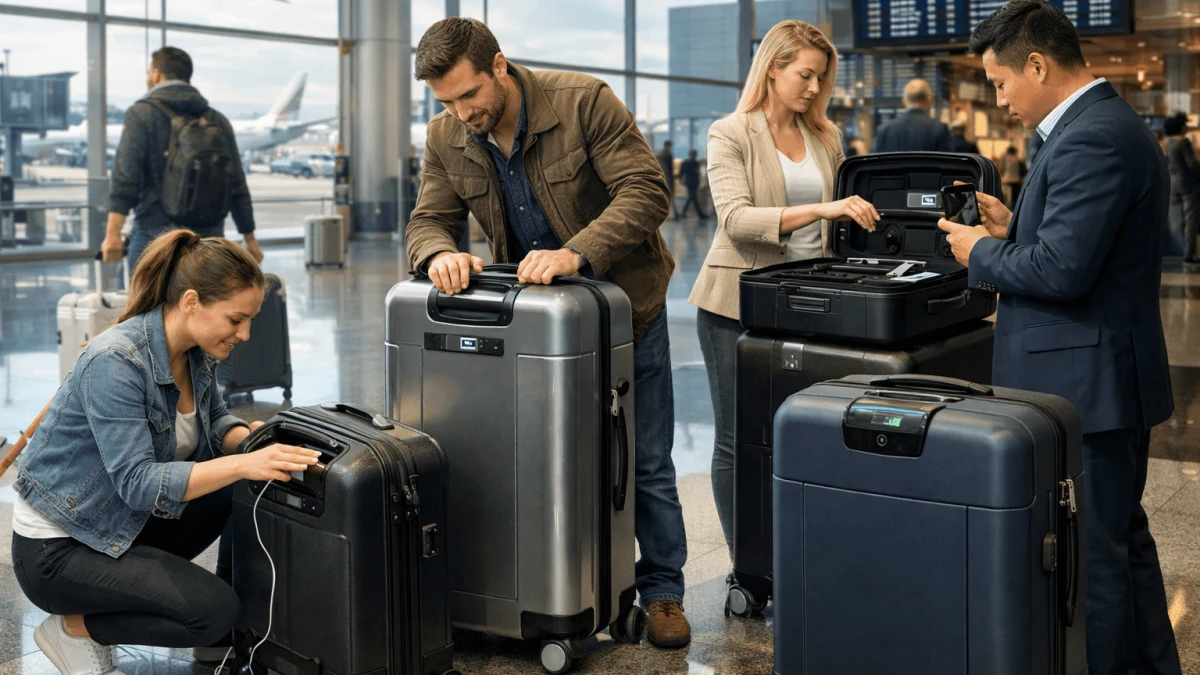
Electric suitcases may not always save time or strain. Smart luggage has compliance issues with airline battery rules. User-placed trackers often outperform built-in options.
This guide is based on thorough web research and real user reviews. It explores the benefits and limitations of smart travel gadgets.
Smart Luggage Overview
Is “smart” actually solving a travel problem you have, or just moving it around? Most connected bags and newer travel gadgets aim to reduce friction—charging on the go, app-based controls, alerts, and other conveniences. In practice, the impact depends on whether those conveniences match the moments you’re most stressed: tight connections, gate-check surprises, and navigating unfamiliar streets.
The trade-off is that every added system introduces another thing to manage—pairing, charging, updating, troubleshooting—often at the exact time you want less to think about. If you already travel smoothly with a simple carry-on, the “upgrade” can feel like extra overhead rather than relief.
Convenience features matter most when they remove a repeated pain point, not when they add new routines. Evaluate by mapping features to specific failure moments: phone dying during a reroute, needing to weigh a bag before a budget flight, or wanting to know if your bag is opening. What not to expect: seamless “set-and-forget” behavior across years, devices, and operating system updates. Apps change, permissions reset, and Bluetooth pairing can fail at inconvenient times.
A common mistake is buying a bag for a feature you’ll only use in ideal conditions. Many smart functions work best on smooth floors, with time to set up, and with consistent phone connectivity. Another mistake is assuming “smart” implies higher build quality; durability is often unrelated to electronics. If you’re tempted, prioritize boring reliability signals: warranty clarity, repair pathways, and whether core travel tasks (rolling, lifting, fitting in bins) remain excellent even when the smart layer is ignored.
Battery and Compliance Challenges
The biggest reason smart or powered luggage disappoints is not performance—it’s rule friction. Lithium batteries create edge cases at check-in, security, and the gate, especially when a carry-on becomes a last-minute checked bag. The practical impact is simple: you can end up repacking on the floor, delaying a line, or losing access to the feature you paid for during the very trip you wanted it most.
Even when rules are straightforward on paper, enforcement varies by airline, route, and individual agent. The trade-off is convenience versus predictability: you may gain onboard charging or powered movement, but you accept a higher chance of “special handling” moments and extra prep before every flight.
Air travel generally rewards anything that keeps lithium batteries controlled and accessible in the cabin. Evaluate any battery-powered luggage by answering three questions before you buy: Can the battery be removed quickly without tools? If you’re forced to check the bag, do you have a simple plan to pull the battery out and protect the contacts? And is the battery size within common airline limits without needing special approval? What not to expect is universal treatment across carriers—even if it worked last year, a different route or partner airline may interpret policies differently.
Typical mistakes are operational, not technical. People forget the removal step until the gate, pack the bag so tightly they can’t access the battery module, or don’t know where the battery release is under stress. Another frequent error is treating an installed battery like a normal “built-in” device; airlines often treat luggage batteries differently because the bag can be checked, stored, and handled in bulk. Plan for the worst-case scenario: a gate-check on a full flight. If the product can’t handle that smoothly, its real-world value drops sharply no matter how nice it feels on a calm trip.
Tracker Performance
Trackers feel like an obvious upgrade—until you define what “works” means. Finding your suitcase on a map is not the same as getting it back quickly, and it doesn’t automatically change an airline’s process. The real practical impact is usually about reducing uncertainty (Is it in the same city? Did it make the connection?) and giving you better information for a claim or a baggage desk conversation.
The trade-off is reliability versus dependence: built-in systems may tie you to a specific app or subscription, while separate trackers can be easy to replace but depend on network coverage and nearby devices. This is one area where the simplest approach often holds up well, so it’s worth slowing down before paying a premium for integration. If you’re comparing options, it helps to consider what kind of tracking you actually need—and where it tends to fail.
Practical evaluation comes down to where updates come from and how actionable they are. Crowd-sourced Bluetooth networks can be excellent in and around airports because of device density, but they may update less often in rural areas or where smartphone ecosystems are sparse. Cellular/GPS-style tracking can be more independent, but it introduces fees, roaming constraints, and occasional dead zones when bags are inside containers or stacked in ways that block signals. What not to expect: guaranteed live tracking in the aircraft hold, or instant “recovery” without going through airline channels.
Common user mistakes: relying on a built-in tracker without testing it before a big trip; assuming “GPS” means always-on precision; or forgetting that the most helpful moment is often at the baggage desk, not on the carousel. Also, travelers sometimes buy a tracking solution but don’t set up notifications, sharing, or battery checks—turning a good tool into a silent one. The best outcome is not perfect location data; it’s faster, calmer decisions when something goes wrong, with minimal ongoing maintenance.
Durability and Long-term Value
The question isn’t just whether smart luggage works on day one—it’s whether it still works after knocks, rain, curb drops, baggage handling, and years of software changes. Modern travel is rough on gear, and electronics tend to age differently than shells, wheels, and handles. The practical impact of a failure is also different: a broken wheel is annoying; a dead battery module can make a “special” bag feel like a heavy, compromised version of a normal one.
The trade-off is paying for integrated systems that may become harder to service over time. Replacement parts, battery availability, and brand longevity matter more here than most travelers expect—especially if you keep luggage for many years.
Material quality: judge the bag as if none of the smart parts existed. If the rolling experience, handle stability, and corner protection aren’t excellent, the tech won’t compensate—because those are the parts that face daily punishment. Serviceability: prioritize designs that let you replace the parts that wear out first (wheels, handles, batteries) without shipping the entire bag across the country or dealing with unclear policies. What not to expect is abundant third-party repair support; many smart components are proprietary, and “simple” fixes can become brand-dependent.
Typical mistakes happen at purchase and at year two. At purchase, travelers overpay for tech while underestimating how often wheels and handles fail first. Later, they discover the battery or electronics are discontinued, the app experience has degraded, or repairs cost enough that replacing the bag feels easier. Long-term value comes from reducing regret: buy for core durability, treat smart functions as optional, and assume you’ll eventually travel with the bag in “dumb mode” at least once—during a dead battery, a policy dispute, or an app issue.
Mobility and Portability
Electric or ride-assist luggage sounds like a clear win: less pulling, faster movement, less strain. Real terminals are messier. You’ll still face curbs, escalator bottlenecks, jet bridges, restroom turns, crowded security lanes, and the moment you must lift the bag—into a car trunk, onto a scale, over a gap, or into an overhead bin. The practical impact is that mobility gains can be highly route-dependent: long, smooth corridors help; stairs and rough pavement erase the advantage quickly.
The trade-off is added weight and bulk versus occasional powered convenience. If you rarely travel through mega-hubs or you frequently take trains, buses, or walk on uneven streets, the “assist” may turn into a heavier object you wrestle more often than you glide.
Target User Profiles
Whether these investments make sense depends less on being a “modern traveler” and more on the shape of your trips. Frequency, airport size, connection patterns, and how often you check a bag determine whether smart features reduce friction or simply add a new checklist. The practical impact shows up in repeatable moments: weekly commutes through the same terminal are different from two international trips a year with varied carriers and unpredictable rules.
The trade-off is specialization versus flexibility. Gear optimized for one style of travel can underperform when your pattern changes—new routes, partner airlines, older stations without elevators, or mixed transit days.
Frequent flyers: the value is highest when your routes are predictable and your tolerance for small time savings is low. The right question is, “Will this reduce friction every month?” not “Is it cool once?” International travelers: variability is the enemy—more airline partners, more enforcement differences, and more situations where you can’t easily troubleshoot. If you’re crossing borders often, simplicity tends to survive better than tightly integrated tech. Mobility-impaired users: powered assistance can be meaningful, but only if it remains manageable during lifts, transfers, and crowded spaces; otherwise it can become a safety and fatigue issue rather than a solution.
Evaluate by writing down your last three trips and counting: stairs encountered, times you had to lift your bag, gate-check likelihood, and average walking distance in terminals. What not to expect: one device that is equally convenient on planes, trains, cobblestones, and small regional airports. A common mistake is buying based on aspirational travel (“I’ll use it constantly”) rather than the trips you actually take.
Cost-Benefit Analysis
The price premium on smart and electric luggage is easy to justify in theory because the benefits are vivid: faster movement, less worry about loss, fewer dead phones. In practice, the math is uneven. Most travelers can replicate a large share of the functional benefit with a durable bag plus separate accessories—while keeping weight down and avoiding policy traps. The practical impact of the wrong purchase is not just wasted money; it’s paying more for a bag that’s heavier, harder to repair, or stressful at check-in.
The trade-off is integration versus replaceability. Bundled systems can feel elegant until one component becomes obsolete or fails, at which point the whole product’s value drops.
Price vs features: treat each feature as a paid commitment. If it requires weekly charging, app logins, or special handling at airports, it “costs” time in addition to dollars. Comparative value of traditional luggage: durability, wheel quality, and repair access often dominate satisfaction over years; tech rarely compensates for mediocre fundamentals. Travel frequency impact: the break-even point is usually high—if you don’t travel often, you’re less likely to internalize the routines needed to make smart luggage feel effortless.
What not to expect is resale value that tracks the original premium; electronics date faster than shells. Typical mistakes include paying for integrated tracking instead of using a low-cost standalone tracker, or paying for onboard charging rather than carrying a compliant power bank you can replace cheaply. A practical approach is to price the “dumb” setup first (bag + tracker + charger) and then ask what the integrated product adds that you’ll use on most trips, not just on the longest ones.
Charging and Power Features
Charging is the smart-luggage feature that sounds universally useful—and it can be, because travel is full of dead outlets and low-battery anxiety. The real question is whether built-in power meaningfully changes your day compared with carrying your own power solution. Practical impact depends on how you charge: do you top up at the gate, charge while in transit, or rely on one battery for phone, earbuds, and laptop across a long day?
The trade-off is convenience versus control. Integrated charging can be tidy, but it can also lock you into a battery you can’t easily upgrade, replace, or reposition when you need power in your pocket rather than in your suitcase.
Portability of power sources: the most useful power is the power you can access while moving—during boarding lines, immigration queues, or when your bag is overhead. Device compatibility: your charging setup must match what you actually carry, otherwise you’ll end up with adapters and extra cables that defeat the simplicity. Battery life concerns: any power plan fails if you don’t have a routine to recharge it, and travel days are exactly when routines get disrupted.