
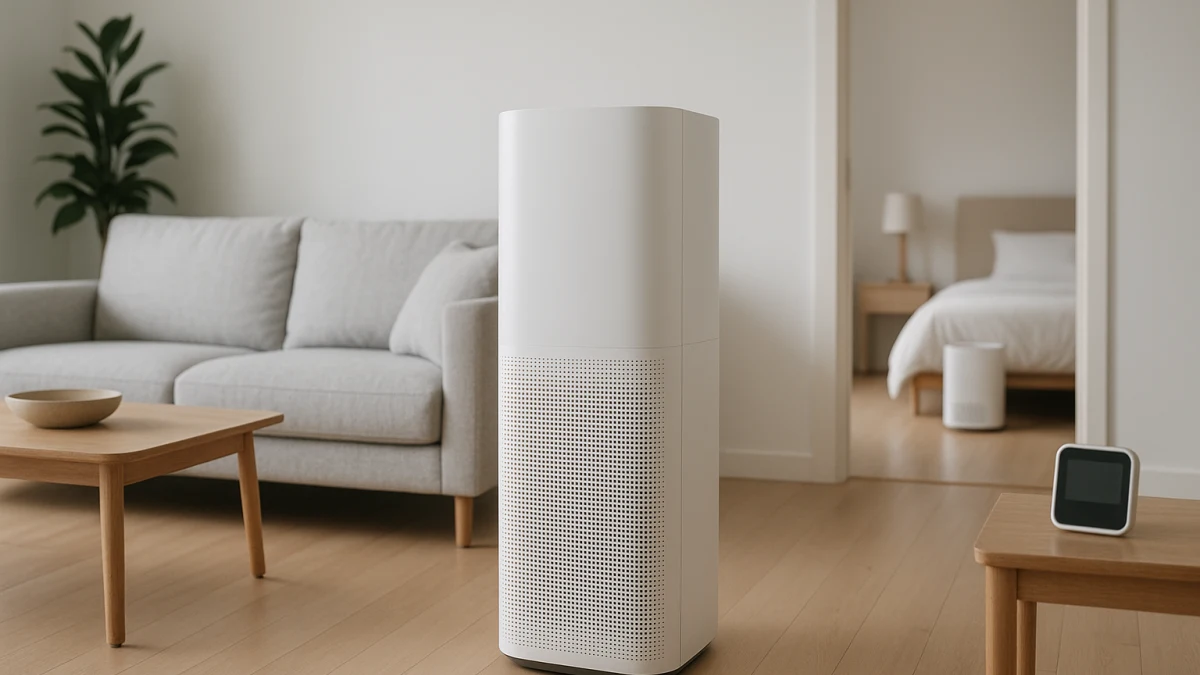
An air purifier’s biggest “up to” square-foot number is not the same as a good room match. A normal product grid can mix compact bedroom models, high-coverage living-room units, and air quality monitors side by side; this guide separates them by room enclosure, CADR, usable fan speed, noise, filter upkeep, and placement.
Use this page to decide what you can actually treat: a closed bedroom, a larger enclosed living room, or an open-plan zone with furniture and hallways in the way. Monitors appear here only as feedback tools for PM2.5 or air quality index (AQI) trends after the purifier has already been sized for the room.
Start With the Room, Not the Biggest Sq-Ft Claim
- Closed bedroom, nursery, dorm room, or home office: a bedroom or small-room air purifier is usually the better fit when sleep-mode noise and a compact footprint matter.
- Larger enclosed living room: look at living-room or large-room purifiers where higher airflow, stronger CADR, and filter replacement cost matter more than small size.
- Open-plan area: treat this as a placement or multi-unit problem, not proof that one portable purifier will clean the whole home.
- Checking trends after placement: use an air quality monitor for PM2.5 or AQI feedback, not as a replacement for CADR-based sizing.
As you compare products shown here, keep six checks together: room enclosure and layout, CADR versus advertised coverage, usable fan speed, noise in the actual room, filter upkeep, and whether any monitor features are only helping you evaluate placement.
Match the Purifier to the Room You Can Actually Treat
The first decision is not brand or app control. It is whether the purifier will run in a closed room, a larger enclosed space, or a partially connected open area.
- If the door is usually closed and the purifier can sit near the bed, crib, desk, or work area, prioritize quiet low-speed operation and right-sized coverage.
- If the room is larger and people will tolerate more airflow noise during the day, step up to stronger CADR and compare filter costs.
- If air has to travel around furniture, hallways, walls, or separate zones, do not assume one high-coverage badge solves the whole layout.
- If you want feedback, measure trends after placement; do not let a monitor become the sizing method.
Read “Up To” Square Feet Through CADR and Air Changes
Square-foot coverage depends on assumptions that may not be identical from product to product. Ceiling height, fan speed, room conditions, and the air-change rate behind the claim can all change what the number means in practice.
That is why a compact listing with 108, 157, 250, or 285 sq ft coverage is not automatically comparable to a bedroom-labeled listing claiming 1095 or 1110 sq ft, and a large-room listing at 2400 or 3000 sq ft should not be read as whole-home performance. When CADR is listed, use it as a cleaner airflow clue, then check whether the stated coverage is tied to a specific air-change assumption and a fan speed you would actually use.
Portable Purifiers Stop at the Room Boundary
This collection is about portable air purifiers for a single bedroom, small room, living room, large room, or open-plan zone. It does not cover whole-house HVAC filtration, ducted air cleaners, box fans, industrial air scrubbers, or window fans.
A portable unit can help in the room where it is placed, but it should not be treated as cleaning several closed rooms at once. For open layouts, think in terms of airflow paths, placement, and whether more than one unit is more realistic than one oversized purifier.
Bedroom or Small-Room Purifiers: Size for Sleep Speeds, Not Sticker Coverage
Use this group for enclosed bedrooms, nurseries, dorm rooms, guest rooms, kids’ bedrooms, and home offices where the purifier can run close to the sleeping or working area. In these rooms, quiet operation at a usable setting often matters more than the biggest maximum coverage number.
Compare stated coverage, CADR if listed, sleep-mode or low-speed noise, filter type, and replacement interval. Some compact listings show clearer small-room signals such as 108 sq ft, 157 sq ft, 250 sq ft, or 285 sq ft; some bedroom-labeled products advertise broader figures such as 430, 570, 1095, or 1110 sq ft. Treat the broader numbers as a prompt to check the assumptions, not as a guarantee that the unit fits every bedroom situation.
Read the products shown here as candidates for enclosed small-room use. If a listing emphasizes sleep mode or very low noise, check which fan setting that refers to and whether that setting still gives you enough airflow for the room. If the room is a living room, open area, or a space where the door is rarely closed, move to the large-room lane instead of stretching a compact model beyond its role.
When a Bedroom Label Is Too Small, and When Large-Room Power Is Overkill
Common wrong turns usually come from trusting the label before the room:
- Buying a bedroom-labeled purifier with a very broad “up to” claim for an open living area without checking CADR or air-change assumptions.
- Paying for a large-room unit in a small bedroom where medium or high speed is too loud to use overnight.
- Comparing 108 sq ft and 1110 sq ft claims as if they were measured under the same conditions.
- Ignoring filter replacement cost, especially when stepping up to a higher-output purifier.
The right size is the one that can deliver enough clean air in the actual room at a fan speed the household will tolerate.
Living-Room or Large-Room Purifiers: Higher CADR Without Whole-Home Claims
Step up to this group when the room is larger, more open, or used during the day with enough space for a bigger unit. These products are a better fit for living rooms, larger enclosed rooms, and open areas where higher airflow and CADR matter more than a compact footprint.
Large-room listings can show very wide coverage claims, including figures such as 975, 1733, 1800, 1980, 2400, 2500, 2657, and 3000 sq ft. Some also list CADR values, such as 205 CFM or dust, smoke, and pollen CADR around 231 to 259 CFM. Those numbers are useful only when you read them alongside fan speed, noise, room layout, and filter upkeep.
Use the products shown here to compare higher-output options, not to assume one portable purifier cleans the whole house. For open-plan areas, check where the unit can sit, whether air can circulate around furniture and hallways, and whether multiple units would make more sense than relying on one high square-foot claim.
Use Readings to Check Placement, Not to Size the Purifier
An air quality monitor can help you see whether PM2.5 or AQI trends improve after you move a purifier, open or close a door, or change where the unit sits. That is useful feedback, but it is not the same as CADR, coverage, or filtration performance.
Use readings as a before-and-after placement check: near the purifier, across the room, and possibly in an adjacent space. Do not use a consumer monitor reading as certified proof that the purifier is correctly sized.
Air Quality Monitors: A Placement Check After the Purifier Is Sized
This is a supporting tool, not a third purifier category. Look for monitors that show indoor PM2.5, PM10, AQI, carbon dioxide (CO2), total volatile organic compounds (TVOC), formaldehyde (HCHO), temperature, humidity, data logging, app connectivity, Wi-Fi, battery operation, or a clear display if you want to compare trends after placing the purifier.
The products shown here can help you observe what changes after placement, but they do not clean the air and should not replace the bedroom or large-room sizing decision. Skip this lane if you already know where the purifier will sit and do not need trend feedback.
Final CADR, Room, Noise, and Filter-Upkeep Check
Before choosing, confirm these points on the product page:
- Room match: Is the purifier for a closed bedroom, a larger enclosed room, or an open-plan zone?
- Coverage assumptions: Is the square-foot claim tied to a clear air-change rate, ceiling height, or fan speed?
- CADR: If CADR is listed, does it make sense for the room compared with the coverage claim?
- Usable noise: For bedrooms, check sleep-mode or low-speed noise. For living rooms, check whether medium or high speed is tolerable.
- Filter upkeep: Confirm filter type, replacement interval, and expected replacement cost.
- Placement: Make sure the unit can sit where air can circulate instead of being blocked by walls, furniture, or hallways.
- Monitor role: If using a monitor, treat PM2.5 or AQI trends as placement feedback, not purifier sizing proof.
Choose the smallest purifier that can deliver enough clean air for the actual room at a fan speed people will use. Then refine placement, and use optional trend monitoring if it helps, without treating any portable unit as whole-home filtration.